
Wargaming and the Proliferation of VTTs
July 19, 2026 · Mitchel Pigsley
July 19, 2026 · Mitchel Pigsley
Picture it. It’s your very first time hosting an online TTRPG game night for friends. You’re confused over how to run a game online, so you turn to the internet. Your first mistake. The advice you come across time and time again is to “just use a virtual tabletop.” So you download Foundry or log in to Roll20 and are met with a blank canvas. It’s at this moment that you realize you are no longer preparing for the best storytelling adventure the world has ever seen and will instead be learning new and complicated software for the rest of the night. The non-alcoholic seltzer in your hand will not be sufficient.
Somewhere between “I want to play TTRPGs online” and game night, VTTs have inserted themselves. Let’s do a rewind. How did we get here? And why are we wargaming in a story about talking squirrels?
Roleplaying games have inherited the gridded battle map.
D&D grew directly out of miniatures wargaming. Gary Gygax's Chainmail was a medieval wargame smuggling a fantasy supplement in its back pages, and the earliest D&D sessions in Lake Geneva were played by people who painted miniatures and hauled around terrain tiles. The lineage goes back further still, to Kriegsspiel, the 19th-century Prussian training game where officers pushed blocks across contour maps while an umpire adjudicated outcomes. That umpire, a neutral human interpreting a messy situation and telling players what happens, is the direct ancestor of the Game Master (GM).
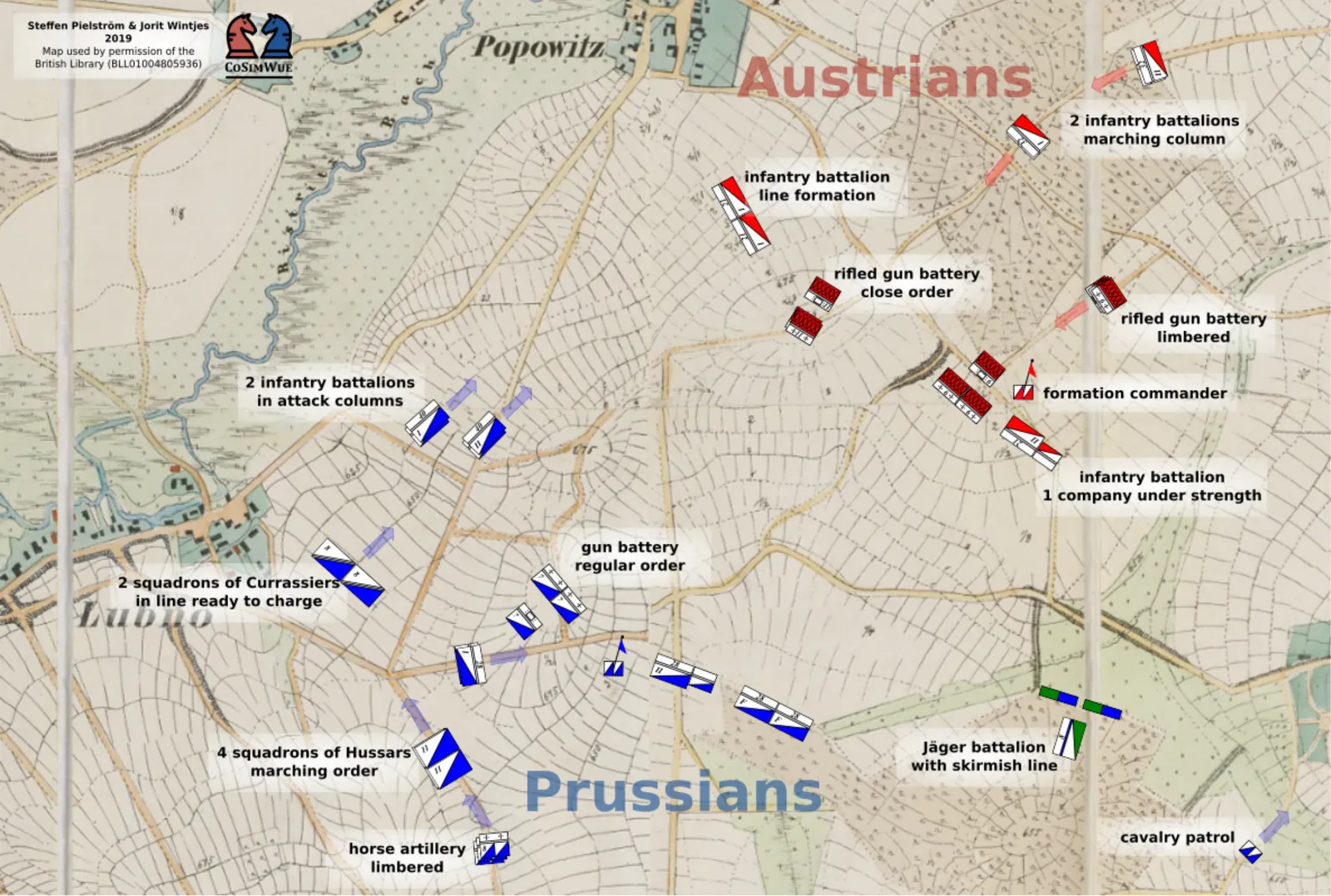
From that lineage, the modern roleplaying game inherited two things at once: the map, with its positions and ranges, and the referee, whose job is to adjudicate everything the map leaves unclear. Early D&D walked the line between rules for group storytelling and rules for wargaming. During this time, pure theater of the mind was a popular way to play for some groups, where combat moved into a shared imagination space between the players. But for many others, the grid never left.
In the 2000s, with the release of D&D 3.0 and 3.5, new rules like attacks of opportunity, five-foot steps, and precise reach made it difficult to keep combat abstract. Theater of the mind was replaced by very specific combat maneuvers. This trend continued into the 4th Edition, where a battle map was all but required. An entire generation of players learned this is what D&D and the growing TTRPG space looked like. Storytelling became inseparable from the grid.
For more information about the history of miniature combat in D&D, check out this fantastic article by Christian Lindke titled “Zones of Control: A History of Miniatures Combat in D&D.”
As play migrated to the internet, tools sprang up to meet the growing demand. Fantasy Grounds appeared in 2004, Roll20 in 2012, and Foundry arrived in 2020. Each one was a digital battle map with dice and character sheets. Their original intent was never to facilitate group storytelling but to simulate a tabletop with moving miniatures.
Then 2020 happened. The pandemic forced many gamers into online spaces overnight. These VTTs stopped being one option among several ways to play and became the default answer to "how do we play remotely?" New players during that period often never experienced anything else. The VTT didn’t just support the game. It was the game. Yet another generation came to equate tabletop storytelling with wargaming.
The pandemic is not solely responsible for the waves of new players that have entered the hobby. Media like Critical Role, Stranger Things, and Baldur’s Gate 3 drove entirely new nerddoms to Dungeons & Dragons, and with them came new norms. Players now find tables through Reddit, Discord LFG, and services like StartPlaying; a paid-GM economy has professionalized the role and raised the production bar; safety tools and session-zero culture have taken hold, part of how minorities and LGBTQ+ players found a freedom of expression in the hobby; and Discord has become the de facto home for async storytelling, with living lore channels, between-session role-play, campaign summaries, and quest tracking. Every one of these norms trained the hobby to reach for a tool.
Now, in 2026, when someone asks how to start an online campaign in any large community, the first response is a software recommendation. And no wonder.
These tools are complicated, and nearly all of that complexity lands on the GM. I have lost entire evenings to drawing walls for dynamic lighting and configuring token vision when what I wanted to prep was a rival faction's next move, or the rumor the players would hear at the market. VTTs don’t just take time from the game. They take the time I need for preparing a new NPC or detailing the border settlement the players are visiting next session.
A detailed Foundry or Roll20 scene with dynamic lighting, automated conditions, triggered macros, and a soundtrack is a genuine spectacle. Tools like TaleSpire close the gap between VTT and video games, and the screenshots are indistinguishable from an isometric RPG. If scene-building is a craft you genuinely enjoy, there has never been a better time for it. But notice the asymmetry: the players are having a video game experience, and the GM is having a game development experience. Both can be hobbies. They’re just not the same hobby.
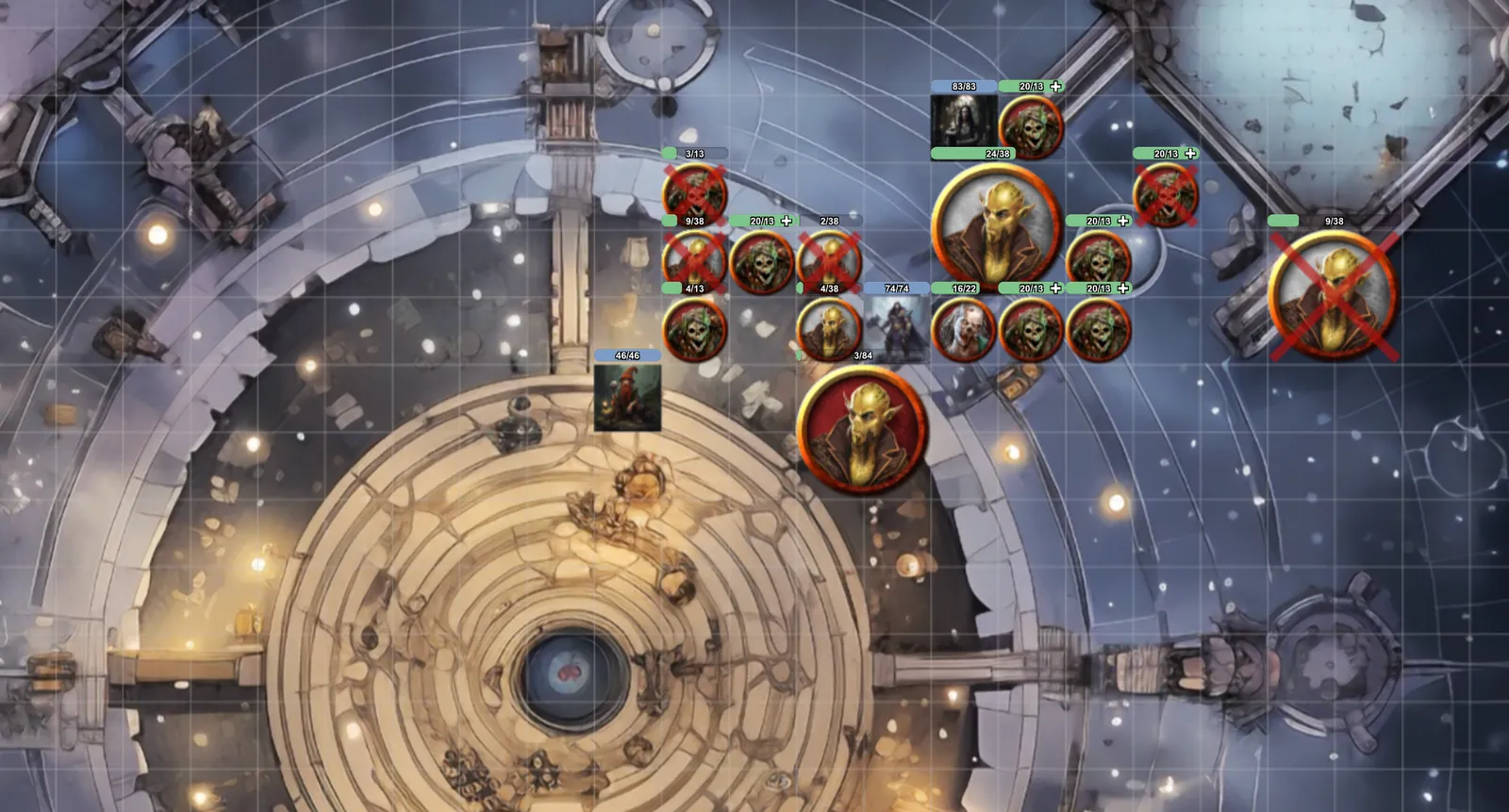
The subtler cost is what a finished scene does to improvisation. A roughly shaped square with a door allows everyone at the table to fill in its gaps without thinking. A fully rendered room is complete, so the gaps no longer register as gaps. If the software draws a 40-foot chamber with a bookcase, then the room is forty feet and a bookcase. Players stop asking whether there's a chandelier to swing from, because the game has already answered every question. The map stops being a storytelling aid and becomes a boundary for the story. This is the point where online play turns into a slow video game for me.
The grid taxes the GM's hours before the session and the table’s imagination. The cost is paid by the one thing the hobby actually runs on: shared storytelling. Which raises the question of what happens when you stop paying that cost?
Strip it back and ask what online play actually requires. Voice. Dice everyone trusts. A way to share the occasional image or note. That's it.
None of this means VTTs are bad. For a game that genuinely lives on tactical positioning, a good map is a pleasure, and some people sincerely enjoy the craft of building a Foundry scene the way others enjoy painting minis. This is a large chunk of our hobby.
But it's worth being honest that it's separate. The question every group should ask is, are we using this because our game needs it, or because it's the default? Because the default was set by a specific lineage, wargame roots, a grid-heavy era, and a pandemic, not by anything essential about roleplaying.
Before you leave the VTT, you first need the right game, so come with me and let’s explore the wide world of rules-light, story-forward TTRPGs.
“But my game needs the grid.” Maybe yours does. Plenty don’t, and a whole movement has spent the last decade building games that prove it. The New School Revolution (NSR), originally a split from the Old-School Renaissance (OSR) as “New OSR,” is the corner of the hobby I call home. Mothership, Mörk Borg, Brindlewood Bay, Cairn, Knave, and so, so many more have all escaped the grid in one way or another.
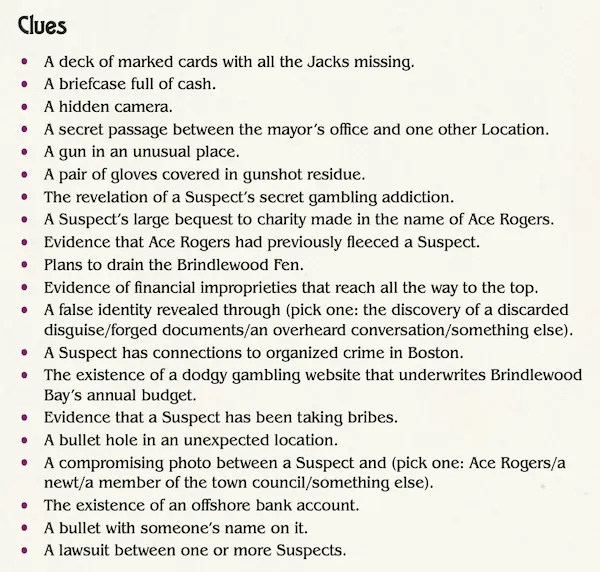
Let’s start with games that use cards instead of maps. Brindlewood Bay uses clue cards to divorce the discovery of a clue from the clue itself. The mavens of Brindlewood Bay might break into a car and discover any number of possibilities: a photo of the deceased with a secret lover, a bloody shirt, or a weapon (see example below). Games like His Majesty the Worm use a set of Tarot cards, while many solo and journaling games use a standard pack of playing cards.
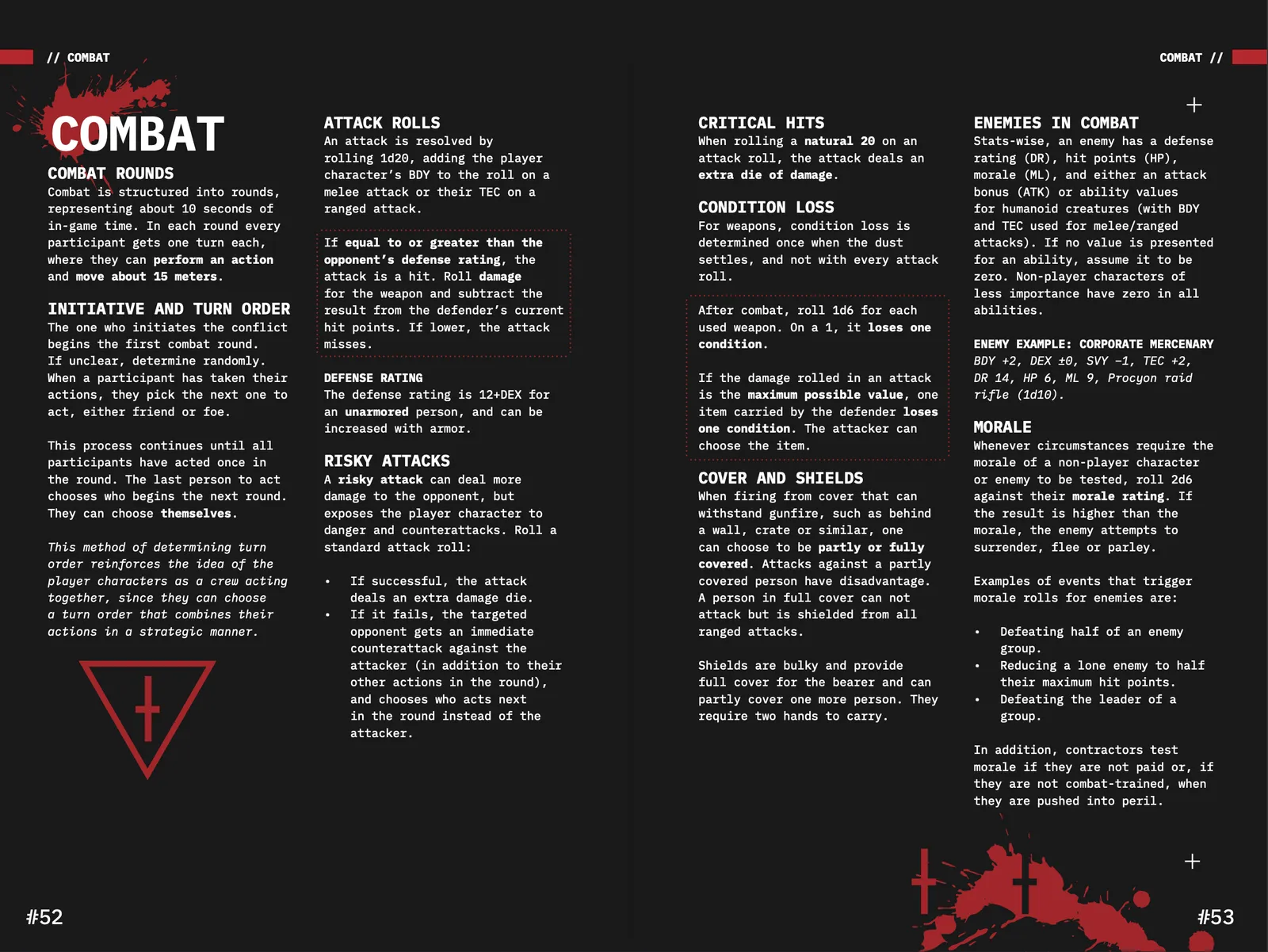
The most common grid alternative is zones. Fate Core, Achtung! Cthulhu, Year Zero engine games like Mutant: Year Zero, and smaller, scrappier games like the Index Card RPG all use zones. The lead designers of D&D 3e and 4e, Jonathan Tweet and Rob Heinsoo, created 13th Age with zones after having heavily invested in grid-based gameplay. Weapons, tools, and equipment have effective ranges that cleanly fit within radiating zones around a character or enemy during combat. Combat is distilled down to a set of distance-based relationships. For small skirmishes, the table can play this style as theater of the mind, but as combat becomes more complex, it becomes difficult to do so without play aids.
Some games escape the grid with dead-simple combat mechanics, which lend themselves to fast, decisive engagements. Death in Space and Mörk Borg both have combat that can be defined on a single printable page. When the players enter a typical “dungeon crawl,” a map begins to make sense, but even that can be abstracted. Mothership and many of its official and unofficial supplements simply provide areas and their relationships, using boxes and lines to show those relationships. None of these games dropped the grid to be clever; they dropped it because the story never needed it.
The games solved this problem at the table. The software is only now catching up. And the useful way to sort that software is not by feature list but by what each tool treats as its subject. The VTT descends from the battle map. Everything in this section descends from the notebook and the conversation.
Tools for the table cover the session’s logistics, and the stack is almost embarrassingly small. Discord with a dice bot like Avrae or Dice Maiden covers voice, trusted rolls, and shared handouts. When the table genuinely wants a visual, Owlbear Rodeo is a shared canvas players join from a link, no accounts, running in under a minute. It is a whiteboard, not a game engine, and that is the entire appeal. If your table wants mood instead of maps, Alchemy bets on cinematic theater of the mind, with art, music, and ambiance in place of a grid.
Tools for the world treat the setting as an authored artifact: the campaign wiki. World Anvil is the maximalist suite, wiki articles, interactive maps, timelines, and a massive community. LegendKeeper is the polished one, with the smoothest interface in the category and thoughtful player-sharing permissions. Kanka is the free, community-driven option built from the ground up for RPG campaigns, with quests and calendars as first-class objects. And plenty of GMs skip the category entirely and build their campaign wiki in Obsidian or Notion, tools they already live in.
The caveat with world-building tools is that they share a hidden flaw with the VTT. They are tools you feed. Every article, every timeline entry, every cross-link is prep, and a GM can vanish into World Anvil as completely as into Foundry.
Tools for the story are the new category, and the first one that inverts the relationship. Their subject is the campaign as it unfolds, and they are fed by play rather than demanding you feed them. Archivist and Realms of Shod attach to wherever your table already is by transcribing your sessions, extracting world-state into a compendium, and helping you answer hard questions live or during your before-game prep. We are building Realms of Shod for live play and collaborative storytelling that reaches past the play group into the community. A realm is a world that keeps growing between sessions and across tables, so the lore doesn’t stop accumulating when a session ends, and what one group builds, the next can pick up and carry further.
The premise of this category is simple: your table’s scarcest resource is not visualization. It is memory. You talk, the software remembers, and the GM’s evenings go back to the rival faction’s next move.
Same friends, same game night, same insufficient seltzer. But this time, when the internet says, “just use a virtual tabletop,” you don’t. You open a voice channel and a two-page rulebook. There is no blank canvas, because there is no canvas.
Are VTTs necessary? No. Are they fun? Sometimes, but it’s one kind of fun, installed as the default for every table, including the ones telling stories about talking squirrels.
Behind the maps of the original Kriegsspiel stood the umpire, a human telling the players what happens. Two hundred years later, that is still the only equipment the hobby cannot run without. We inherited the map and the referee together, and we automated the wrong one.