
The short answer is yes. The better answer is more useful.
Can AI Be Your Dungeon Master? An Honest Look at AI DMs in 2026
Yes. In 2026 you can sit down alone at 2 a.m., or with three friends and nobody willing to run, and play a full session with an AI narrating the scene, voicing the NPCs, and rolling for the monsters. Several platforms do this well, and the category has grown from a curiosity into a crowded market with real money behind it.
This page compares the main options honestly and says who each one is for. Realms of Shod doesn't make an AI dungeon master, and we'll explain why. It isn't squeamishness about AI; we use it in every session. It's that after looking closely at why campaigns fail, we think AI's best job at the table is a different one.
Four Jobs AI Can Do at a Table
“AI dungeon master” gets used for very different tools. It helps to separate them by the job they actually do.
| Job | What it looks like | Examples |
|---|---|---|
| Prep | Generating NPCs, maps, encounters, names, and loot before the session | NPC and map generators, general chat assistants |
| Run | Narrating, voicing NPCs, and resolving actions in real time | AI Dungeon, Friends & Fables, LoreKeeper, Old Greg's Tavern |
| Remember | Recording what happened, organizing it, recalling it later | Session transcription and recap tools, including Realms of Shod |
| Assist | Helping a human GM mid-session or between sessions | A general assistant connected to your campaign record |
Most of the debate about AI in tabletop games is really about the second row. That's where to start.
AI Dungeon Masters Compared
Pricing and features change quickly in this category, and several of these products have raised prices or restructured their tiers within the last year. The table reflects what each product published on its own site as of September 2026; check before you subscribe.
| Style | Multiplayer | Best for | Watch out for | Starting price | |
|---|---|---|---|---|---|
| AI Dungeon | Freeform text adventure in any genre | Solo | Open-ended fiction with no rules to learn | No real mechanics; long stories can drift | Free tier; paid from $14.99/mo |
| Friends & Fables | AI GM with maps and tokens | Yes | Groups who want grid combat with an AI running it | Free tier is capped by daily turns | Free tier; paid from $19.95/mo |
| LoreKeeper | AI GM on a D&D 5e rules engine | Up to 6 | Solo players or small groups who want real 5e mechanics | Built around fantasy 5e | Free tier; paid from €7.99/mo |
| Old Greg's Tavern | Mobile-first AI GM | Up to 5 guests, free on the host's credits | Short solo sessions on a phone | Adventures are episodic rather than long campaigns | $5 one-time, then from $15/mo |
| ChatGPT or Claude with a prompt | General assistant you configure yourself | Workable with effort | Tinkerers who want total control | You build and maintain the rules, structure, and campaign state | Free tiers; paid plans around $20/mo |
Where AI Dungeon Masters Shine
This deserves saying clearly, because the hobby's arguments about AI can drown it out. AI GMs solve real problems.
- Nobody will run. Looking-for-group boards are full of players waiting for a GM. An AI GM means the game happens at all.
- Solo play on your own schedule. A full session at 2 a.m. with no scheduling is a genuinely new thing.
- The forever-GM finally gets to play. Someone who has run every campaign for a decade can sit on the other side of the screen.
- Learning. New players can learn a system without holding up a whole table.
- Genre tourism. Trying cyberpunk noir on a Tuesday costs nothing.
Where They Break
Memory
Long campaigns are hard for AI. Language models work within a limited window of recent text, and anything outside that window has to be stored and retrieved deliberately or it's gone. Freeform tools are known for drifting over long stories. The AI GM platforms treat this as the central problem themselves: LoreKeeper, which makes one, publishes a four-part test for AI DMs, and its first axis is continuity, meaning whether the game still remembers session one by session twenty.
Agreeableness
Language models are trained to be helpful, and at a game table that can mean saying yes too often. A good GM says “yes, and,” but also “no, but” and “you can try.” Stakes need resistance. Without a rules engine or a firm hand, an AI narrator can let the story go soft.
The table itself
A human GM notices the quiet player who hasn't spoken in an hour, the friend having a rough week, the joke that only lands because of something that happened three campaigns ago. An AI sees text and whatever else you give it. Some of that gap will narrow. Some of it is the reason people play together at all.
Authorship
A world generated by a model is a world nobody at the table made. Some groups don't mind; the fun is in the playing. Others care a great deal that the world is theirs. Neither is wrong, but it's worth knowing which kind of table you are before you choose.
The Question Behind the Question
People search “can AI be a dungeon master” for a few reasons. Nobody in the group will run. The person who does run is exhausted. Or the campaign keeps dying, and someone wonders whether a machine would be more reliable.
Look at why campaigns actually stop and a pattern appears. Scheduling falls apart. The GM burns out. Nobody remembers what happened three sessions ago, so coming back feels like homework. Those failure points are the same for human tables and AI ones. The hardest problem AI GM makers are working on, continuity, is the same problem that ends human campaigns.
The GM was never the scarce resource. Memory is.
So we asked a different question: what if AI took the part of the job that's tedious, invisible, and draining, and left the part that's creative and human to people?
| Job | Best held by | Why |
|---|---|---|
| Imagining the world | People | It's the reason to play |
| Voicing NPCs and reading the room | People | This is where a table's chemistry lives |
| Rulings | People, or a rules engine | Consistency with judgment |
| Remembering every word | AI | Perfect recall is tedious for people and trivial for software |
| Filing NPCs, places, and factions | AI, with human approval | Structure without the busywork |
| Catching up absent players | AI | In-world rumors instead of a GM recap |
| Prep drafts | Your call | Some GMs love it, some don’t |
How Realms of Shod Uses AI, and Where It Stops
In Realms of Shod, AI listens, distills, and structures. It transcribes the session with speaker attribution, breaks it into scenes, writes recaps and summaries, and files characters, places, and items into a compendium that learns your homebrew names and their nicknames. When a player misses a session, it writes them a rumor: a short, in-world hint built only from what their character could plausibly have heard.
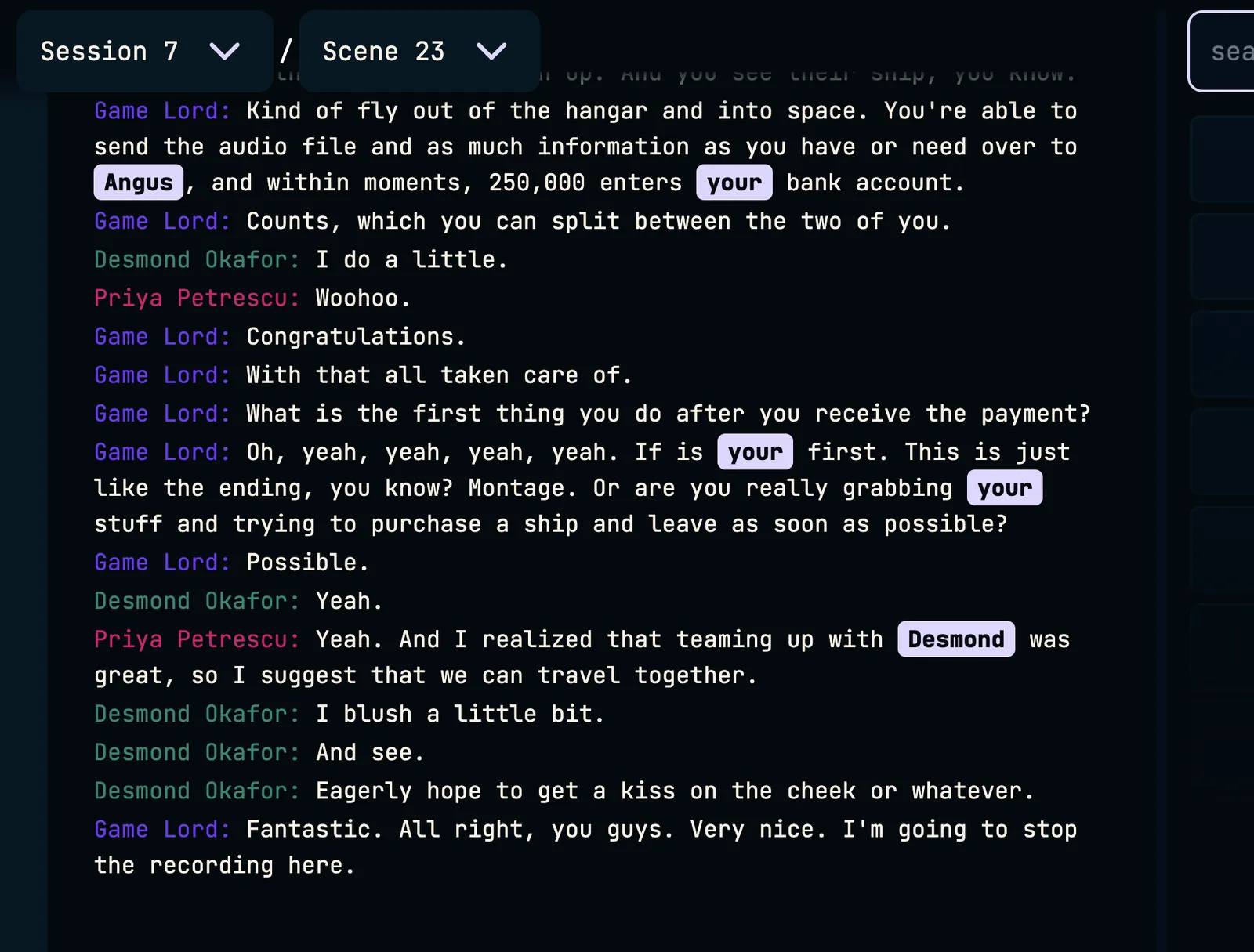
It doesn't narrate, voice NPCs, make rulings, or invent your world. Recording is off by default, every AI feature is opt-in, and there are no ads, no tracking, and no data selling.
Bring Your Own AI Game Master
If you do want an AI running or co-running your game, Realms of Shod can be its memory. A realm is open to AI assistants through MCP, the Model Context Protocol, and connects to Claude, ChatGPT, Cursor, Copilot, and others. A connected assistant can read your sessions, transcripts, compendium entries, and relationships directly, and with the Collaborator role it can create and update entries too.
That changes what an AI helper can do. Instead of improvising from a blank page, it works from your campaign's actual history. A few things GMs ask for:
- “Before tonight, list every NPC the party has lied to and what each one believes.”
- “Which plot threads from the first ten sessions never paid off?”
- “Draft three rumors the thieves' guild would spread about the fire at the mill.”
- “Run a short solo scene in the port city using only NPCs already in the compendium.”
The AI you choose brings the voice. The realm brings the memory. Your table decides where the line sits.
Connect an AI assistant with MCPAI Dungeon Master FAQ
Can ChatGPT be a dungeon master?
Yes, with setup. A good prompt gets you a capable narrator for a scene or a one-shot. Over a campaign, the challenge is state: which NPCs exist, who owes whom, what the party already knows. Connecting the assistant to a realm through MCP gives it a real record to read instead of whatever you remember to paste in.
Is Realms of Shod an AI dungeon master?
No. It uses AI to listen, remember, and organize. A human runs the game, or an AI you bring yourself does.
Will AI replace human dungeon masters?
We don't think so, and we aren't building toward it. AI GMs will keep improving for people who have no GM. For groups that do have one, the bigger opportunity is taking the drudgery off that person's plate.
Is using AI at the table cheating, or unethical?
That depends on the table and the tool. Some groups want nothing AI-made in their world. Others are happy to let software handle the notes. Talk about it at session zero, the same way you would agree on recording or on lines and veils. In Realms of Shod, recording and every AI feature are opt-in, and the AI does not write your world’s content on its own.
What is the best AI dungeon master for solo play?
For real D&D 5e mechanics, LoreKeeper is built for it. For freeform fiction in any genre, AI Dungeon. For a solo game that remembers a world you are building over months, connect a general assistant to a realm through MCP and play there.
Can AI help a human DM during a live session without running it?
Yes. In a realm, scene recaps appear as each scene closes, spoken names link to their compendium entries, and if a hidden entity comes up, the GM gets a quiet prompt to reveal it. The GM stays in charge of everything that matters.
What happens when a player misses a session?
By default, they get a rumor rather than the transcript: a short piece of in-world hearsay about what changed, built from what their character could have heard. The GM can grant full access to a session or turn rumors off for the whole realm.
Keep the storytelling human. Let the machine remember.
The best use of AI at a table might not be the loudest one. Realms of Shod is free to start, the MCP connection is free, and signing up comes with a coin bonus to try transcription and recaps on a real session. If you want to see what it produces first, read a real D&D session recap.