
Six days of silence, one night of play.
What to Do Between D&D Sessions: 12 Ideas for Players and DMs
A weekly game is four hours of play and six days of waiting. What happens in those six days decides whether players arrive excited or arrive asking what happened last time. This guide gives you twelve proven ways to keep a campaign alive between sessions, sorted by how much work each costs the DM, and advice on picking the right two or three for your group.
Then it asks why nearly every idea on every list like this one runs through the same overworked person.
The Quick Answer
| Idea | Who drives it | DM effort |
|---|---|---|
| Warm-up question posted midweek | DM | Very low |
| Downtime activities by message | Players, DM resolves | Medium |
| Letters or journals from characters | Players | Very low |
| Flash fiction from the world | DM | Medium |
| Short one-on-one scenes | DM and one player | High |
| Faction or world updates | DM | Medium |
| Recap posted the day after | DM or a player | Low |
| Theory channel | Players | None |
| Character art and playlists | Players | None |
| Shopping and crafting by message | Players, DM approves | Low |
| Bastion or base turns (2024 rules) | Players, DM resolves | Medium |
| A short backup one-shot | DM | High |
The best mix for most groups: one thing the DM posts, one thing players do on their own, and a recap.
12 Ideas, With What Each Costs
1. A midweek warm-up question
Post one question in the group chat: “What did your character spend their share of the dragon hoard on?” Players answer in a sentence. You get material for next session, and the campaign surfaces in everyone's week. It is the cheapest idea on this list and one of the most effective.
2. Downtime by message
Instead of spending the first thirty minutes of a session on downtime, resolve it by message during the week. Sly Flourish suggests sending prompts ahead of time and pointing players to the downtime rules in the Player's Handbook and Xanathar's Guide to Everything. Keep each result to two or three sentences, and make sure at least one consequence comes back later.
3. Letters and journals
Players write a short letter home, a journal entry, or a note to another character. It costs the DM nothing and often produces the best character work of the campaign. Some groups read one aloud at the start of the next session.
4. Flash fiction from the world
A paragraph from the villain's point of view. A town crier's announcement about the party's last stunt. Short pieces like this show players that their actions echo. They take the DM some time, so save them for moments that deserve one.
5. One-on-one scenes
A ten-minute text or voice scene with a single player: visiting an old mentor, following a lead alone. Sly Flourish has recommended exactly this for players who can't make every session. It is generous, and it is expensive in GM time.
6. World and faction updates
A short “meanwhile” post about what the factions did while the party rested. Works especially well if you run faction turns or clocks. See our living world guide.
7. The day-after recap
A short summary posted within a day of the session, while details are fresh. Players reread it before the next game. If a player writes it, credit them in the fiction: their character keeps the party's chronicle.
8. A theory channel
A place where players speculate about the plot. It costs you nothing and tells you exactly what your players think is going on, which is priceless prep.
9. Character art, playlists, and moodboards
Players who draw, make playlists, or collect reference images will do it anyway. Give it a channel and celebrate it.
10. Shopping and crafting by message
Handle purchases, crafting, and spell scribing between sessions so the table doesn't spend twenty minutes at the general store.
11. Bastion turns
The 2024 Dungeon Master's Guide introduced Bastions, strongholds characters gain around 5th level. Their turns fit naturally between sessions. Some GMs have noted the system works best when the table has a clear idea of when base-building happens and why.
12. A backup one-shot
A self-contained one-shot for weeks when the main game can't run. It keeps the group playing without advancing the story. High prep, but reusable.
Picking your two or three
Match ideas to your players, not to the list. Writers will love letters and journals. Tacticians want shopping, crafting, and Bastion turns. Theorists need a theory channel and little else. Busy players benefit most from a short recap. Ask at the end of a session which one sounds fun, try it for a month, and drop anything nobody touches. A small habit the group actually keeps beats an ambitious one that fades by week three.
Why This Question Matters
You searched this because you love your campaign and want it to feel like a world, not an appointment. That instinct is right. Players who stay connected between sessions arrive with plans, remember names, and care about what happens. Players who don't slowly drift, and a campaign rarely ends with a fight. It ends with a string of cancelled Thursdays.
Almost Every Idea Runs Through the DM
Look at the list again. Most of the high-impact ideas require the DM to write, resolve, or respond.
| What between-session ideas provide | What they cost |
|---|---|
| Players feel connected to the world | DM writing time every week |
| Downtime without eating session time | DM resolving each player's activity |
| Personal scenes for each character | DM availability for one-on-ones |
| A world that moves | DM tracking and posting updates |
| A shared record | Someone writing recaps, every time |
One GM writing on Substack about running downtime over Discord described the pattern honestly: going deep between sessions was fun, but it was hard to get players to engage, and when the GM fell behind on homework, the whole thing deflated. They moved downtime back to the table. That is the most common ending for between-session play. Not a failure of imagination. A failure of load.
Player-driven ideas vanish into the scroll
The ideas that need no DM effort, like letters, theories, and art, have the opposite problem. They happen, they are wonderful, and three weeks later nobody can find them. The letter the bard wrote to her sister is somewhere above four hundred memes.
A Campaign That Lives Without the DM Holding It Up
The upgraded frame: between-session play should be something players can start, the world can absorb, and the DM can curate, instead of something the DM must produce. Here is what that looks like in practice:
- Players can begin without waiting. A prompt, a template, or a ritual they run themselves.
- It connects to canon. A letter mentioning the bard's sister should make the sister findable later, not bury her in chat.
- Secrets are allowed. A player can write something private and let the table see only that something exists.
- The DM approves, not authors. Reviewing is fast. Writing is slow. Design for review.
- Catch-up is short. A player who ignored the chat for a week can get up to speed in a minute.
- It doesn't punish quiet weeks. Some players will engage heavily, others not at all. Both should be fine.
You can do a manual version: a pinned prompt each week, a doc where players post answers, and a rule that the DM picks one answer to use next session.
Where Realms of Shod Fits
Realms of Shod sits next to your group chat, not instead of it. Keep the memes and the theories. Add a place where between-session play becomes part of the campaign record.
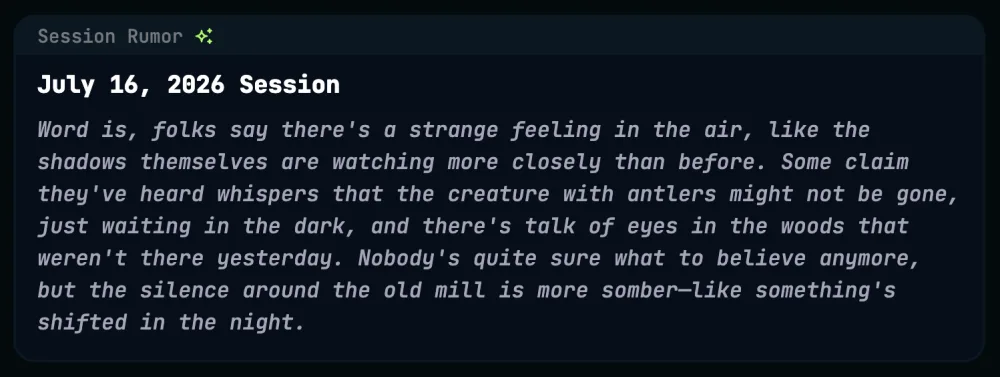
The Gamestream is the realm's feed. Between sessions, it holds what players create on their own time, rather than what the DM found an evening to write.
- Backstory Explorations. A guided set of prompts about a character. Published explorations appear in the Gamestream as their own card. Publish as a Shadow and other players see an AI-rewritten Echo instead of the real answers, while the author and realm admins can read the original.
- Session rumors. A player who missed the last session sees an in-world rumor instead of a transcript, so catching up takes a minute and spoils nothing.
- Recaps that write themselves. Recorded sessions produce scene recaps and a summary, which replaces the day-after recap someone used to write by hand.
- Notes and the compendium. Collaborators and above can write notes and link them to compendium entries, so the bard's sister becomes an entry the Gamelord (our word for GMs) can find and use. Each note stays private until its author shares it.
| Between-session play in a group chat | Between-session play in a realm |
|---|---|
| DM writes most of the content | Players create, the Gamelord curates |
| Letters and answers scroll away | Explorations and notes stay in the realm |
| Secrets go in private messages | Shadows keep the truth hidden in plain sight |
| Catch-up means scrolling | Scene recaps, or a rumor for absent players |
Between Sessions FAQ
How do I keep players engaged between D&D sessions?
Start with one cheap habit: a midweek warm-up question. Add a day-after recap. Then add one thing players can do on their own, like letters or a theory channel. Don't try all twelve.
Should downtime happen between sessions or at the table?
Either works. Between sessions saves table time but depends on players replying and the DM resolving. At the table is more reliable. Many groups do quick downtime at the start of a session instead.
What if my players don't engage between sessions?
That's fine. Some players only want the four hours. Offer the option, reward whoever uses it, and don't make it required for enjoying the main game.
How much between-session work should the DM do?
As little as keeps you excited to run the game. If between-session posting starts feeling like a second job, cut back. Weekly GM homework is one of the more common routes to burnout. If the stress spills beyond the game, talking to someone you trust helps.
Do I need an app for this?
No. A Discord server and a shared doc handle most of this list. An app helps when you want player-created material to stay connected to the campaign without extra work from the DM.
Can players publish backstory in Realms of Shod without the Gamelord?
Backstory Exploration opens from Story Tools, which is available to Collaborators and above. The realm owner decides who holds that role.
Play Once a Week. Live in the World All Week.
A campaign lives in the space between sessions as much as in the sessions themselves. Pick two habits, keep the DM's load light, and give what players make somewhere to land. The best game nights start days before anyone rolls a die.
Starting a realm is free. If you want a first prompt for the group chat tonight, our 40 backstory questions are written to be asked one at a time.