
No fixed party. No fixed night. One world that remembers.
A West Marches Campaign Tool for Multi-GM Worlds
A West Marches game has a simple deal: nobody is guaranteed a seat, the players decide when to go out, and whatever a group finds out there stays found for everyone. The rules fit on an index card. Keeping the world straight between groups is what takes all the work.
Realms of Shod gives a West Marches club one realm to live in. Every GM runs their own sessions in it, every session is recorded into the same compendium, and players who weren't on a trip hear about it as an in-world rumor instead of reading the spoilers. The paperwork that usually sinks these campaigns gets done while you play.
The Quick Answer
| West Marches rule | In a realm |
|---|---|
| Players schedule the trips | Any Collaborator can start a session whenever a group is ready |
| Several GMs share the load | Each GM runs their own sessions in the same realm |
| One persistent world | Every recorded session files into one compendium |
| Parties change every trip | The realm records who was actually in each session |
| News travels through town | Members who missed a trip see a rumor, not the transcript |
| A board full of jobs | Quests in the compendium, from proposed to ended |
| Room for a big roster | A realm holds up to 48 members |
The format stays yours. The realm handles the record: who went where, what they found, and who is allowed to know about it.
Why West Marches Games Stall
West Marches campaigns rarely end because people stop wanting to play. They end because the upkeep lands on whoever cares most, and that person burns out. The same four chores come up in almost every club:
- Session reports. The original format asked players to write up every trip. In practice a few people write long ones for a month, and then nobody does.
- GM handoffs. Two GMs voice the same innkeeper differently, or kill the same NPC twice, because the notes that would have stopped them live in someone else’s doc.
- The wiki. Someone volunteers to keep it. It is excellent for six weeks and then quietly falls behind the table.
- Who knows what. The fun of a shared frontier is hearing about a ruin before you go there. A Discord channel full of full recaps turns that into reading a spoiler.
None of these are game design problems. They are record-keeping problems, and record-keeping is the part software is actually good at.
One Station, Two Crews: A Real Example
Our own Mothership realm is set on Prospero's Dream, a station of nine million people where oxygen gets thinner the further down you live. Two different crews have played there, almost two years apart.
| When | Crew | What happened on the station |
|---|---|---|
| Nov 2024 | The salvage crew | A bulkhead blows in a crowded corridor on Prospero's Dream. A masked figure on the station screens says the oxygen debt of the Choke must be paid. |
| Feb 2025 | The salvage crew | Angus, who runs the CANNONHEAVY.market, offers them a lead worth 250,000 credits: find the source of the bombing footage. They sign on with Teamsters Local for a salvage run instead. |
| Mar 2025 | The salvage crew | Out on the derelict Palantine they find Bratva-marked crates and a note saying the Bratva are to blame. The session ends on a cliffhanger, far from the station. |
| Sep 2026 | A new two-person crew | Priya and Desmond trace a hijacked broadcast to a spliced receiver, a missing coworker, and a ship called the Weeping Dragon. They hand the evidence to Angus and collect the 250,000 credits the first crew never chased. |
The second crew never read the first crew's notes. They didn't need to. Prospero's Dream, the Choke, Angus, and his market were already in the compendium, filed from sessions recorded long before, and the new transcript linked straight to them as they came up. The GM picked up the thread the first crew had left hanging and handed it to new players. A job one party turned down became another party's payday.
That is the West Marches promise in one example: nothing a group leaves on the table disappears. In this case one GM ran both crews. With two GMs, the only difference is who starts the session.
Many GMs, One Compendium
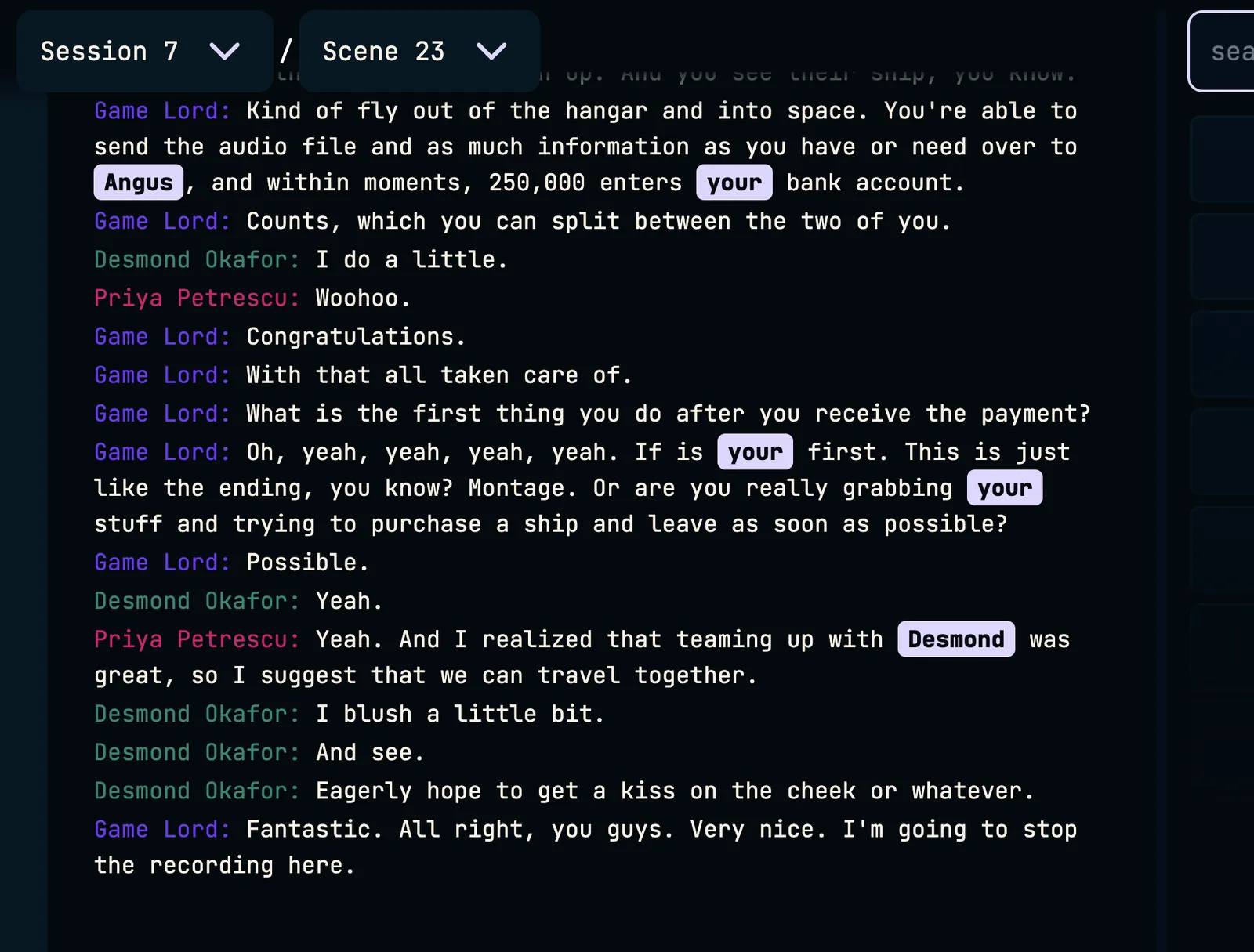
Every GM writes into the same world. Record a session live, through the Discord bot, or by uploading the audio afterward. The people, places, factions, and items that come up are filed into the realm's compendium and linked back to the line of the transcript where they were mentioned. When the next GM preps, the innkeeper already has a page.
Updates wait for a person. When a session teaches the world something new about an entry, the change is proposed, not pushed. A GM approves it, so one table's half-remembered detail doesn't quietly overwrite another table's canon.
Pick roles on purpose. Collaborators can start sessions, add to the compendium, and post quests, which is what most GMs need. Admins can also edit any session and always see every session in full. If your GMs need to read each other's games start to finish, make them admins. If you want each GM to hear about other tables the way players do, leave them as Collaborators. See every permission by role.
Quests as the Job Board
Every West Marches town has a board of work nobody has taken yet. In a realm, that board is the Quests list in the compendium, sorted into Proposed, Active, and Ended. A quest with no steps is still up for grabs. Once a group logs the first step, everyone can see it is in progress.
- A hook and a goal. How the job reached town, and how a party will know it is done.
- An optional reward. The coin, favor, or promise on offer, if there is one.
- A timeline of steps. Discoveries, complications, and decisions, added as groups make progress. The last step decides whether it ended completed, failed, or abandoned.
- Its own visibility. Share a quest with the whole realm to post it on the board, or with specific members to keep it private to one group.
Any GM with the Collaborator role can post a quest, and any group can pick one up on their next trip. A job one party leaves alone stays on the board until someone else takes it. How quests work.
The Rumor Board Writes Itself
West Marches games live on news from other parties. Somebody came back from the northern ruins short a hireling. Something is nesting under the old bridge. You want to hear that before your own trip, but you don't want the whole story, because then there is nothing left to find.
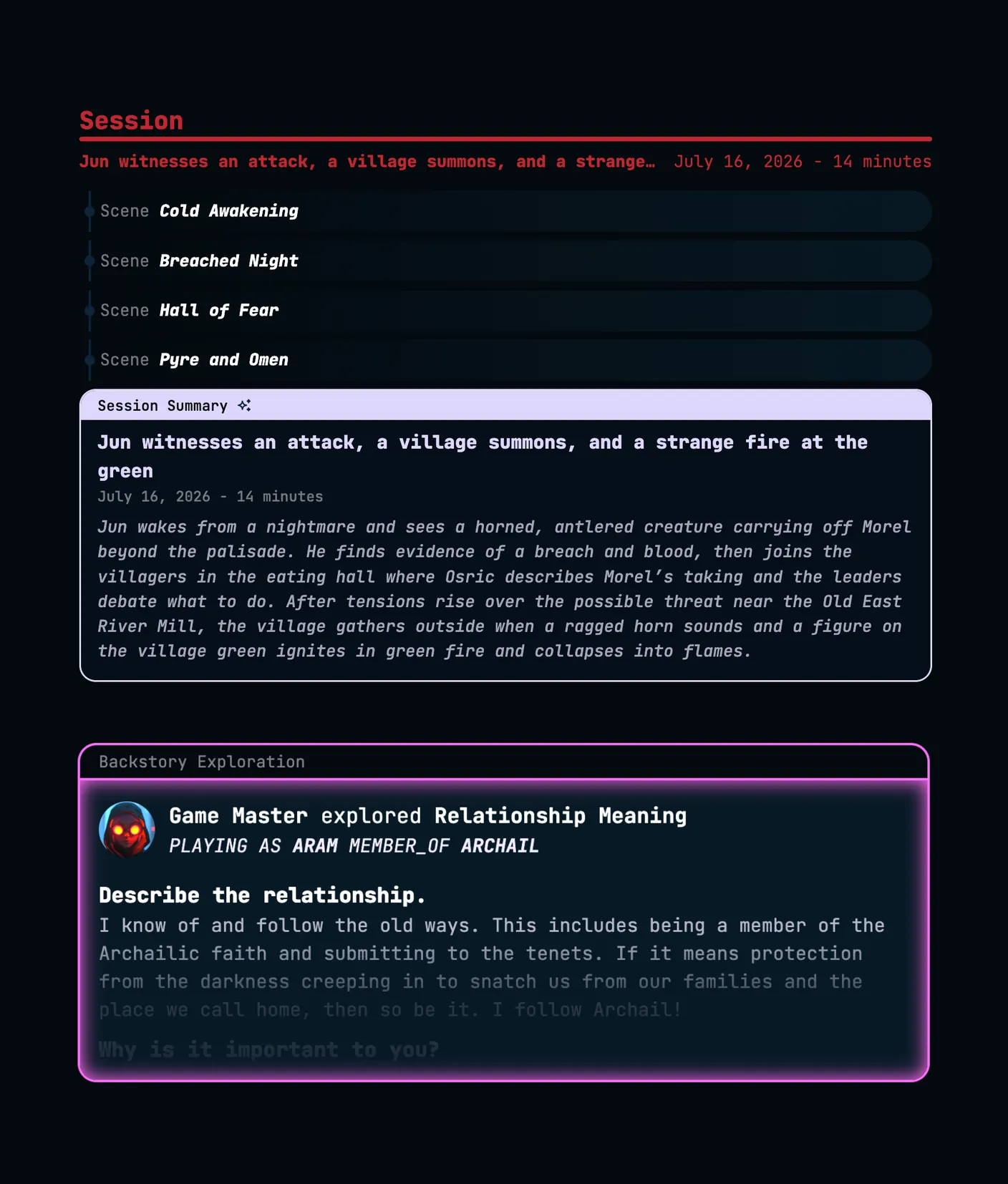
When a group finishes a recorded session, the members who were there get the transcript, scene recaps, and summary. Everyone else in the realm gets a Session Rumor in the Gamestream instead: a few sentences of in-world hearsay about the aftermath, hedged the way gossip is, without saying who did what or how it ended. The rest of the club gets a reason to go out, and the group that went keeps its discoveries.
Rumors are on by default. Admins can turn them off for the whole realm, or open a single session to specific members from its edit form.
See a real rumor next to its session summaryWhat It Does Not Do Yet
Better to hear it here than two sessions in:
- No map yet. Hex crawls are the heart of a lot of West Marches games, and realms do not have a map or hex tracker today. Most clubs keep the map where they already do, such as a shared image or a VTT scene, and file named places in the compendium.
- No scheduling board. Players still arrange trips in Discord or wherever your club already talks. The realm picks up once a session starts.
- Live video tops out at 8. A realm holds 48 members, but only 8 people can be on camera in one live session. That matches how West Marches trips work, but it is a hard limit.
- Rumors can brush against secrets. A rumor is written from the whole session, including compendium entries players have not discovered yet. It is built to stay vague, but when several groups are chasing the same mystery, read it before they do.
West Marches FAQ
What is a West Marches campaign?
A campaign format with no fixed party and no fixed schedule. A large pool of players shares one world, small groups organize their own trips out from a home base, and whatever they discover stays true for everyone. Several GMs often share the load.
What is the best tool for running a West Marches campaign?
You need a shared record of the world, a way to see who played which session, and a way to spread news without spoilers. Realms of Shod handles those three in one realm: a shared compendium, per-session participation, and in-world rumors for members who were not there. It does not have a map yet.
Can multiple DMs run games in the same world?
Yes. Anyone with the Collaborator role can start sessions in a realm, and every session files into the same compendium. Make co-GMs admins if they should be able to read every session in full.
How many players can join one West Marches realm?
Up to 48 members. Any number of them can be in a given session, with up to 8 on live video at once.
Do players still have to write session reports?
They can, but they do not have to. Recorded sessions get a transcript, scene recaps, and a summary automatically, and new people and places are filed into the compendium from the recording.
How do players hear about trips they were not on?
Through session rumors. Members who were not in a session see a short piece of in-world hearsay in its place, so they know something happened out there without being told what.
Does it work for systems other than D&D?
Yes. Nothing in a realm is tied to one ruleset. Our own long-running example is a Mothership game.
Does it have a hex map?
Not yet. Keep your map in whatever tool you use now and record named places in the compendium.
Open the Marches
The best part of a West Marches game is coming back to town and finding the world changed by people you have never played with. That only works if the world keeps track. Let the realm do it, and your GMs can spend their prep time on the frontier instead of the filing.
Realms of Shod is free to start. If you are still deciding whether your club is a West Marches game or something looser, the shared world campaign guide covers the wider family of formats.