
"Hang on, which page of my sheet has the armor on it?"
Online TTRPG Character Sheets That Play at the Table
Most digital character sheets are a form: boxes for numbers, a notes field, and the rules still living in the book. The sheets in Realms of Shod know the rules of the game they belong to. Creation walks a player through their game's own steps, a roll tile actually rolls, and the HP tile takes damage the way the game says it should, armor dice and all.
Each sheet lives inside the realm where the campaign already is, next to the session transcripts, the compendium, and the quest board. And every game is described in the Open Character Format, an open-source format that any tool can build on.
Which Games Have Character Sheets
Each game is a pack: its stats, its creation steps, its rolls, and its gear, written down so the sheet can follow the same rules the table does. The DM picks which packs the realm uses, and a realm can use more than one, so a club running a D&D campaign and a Mothership one-shot on alternate weeks keeps both in the same place.
| Game | Built from |
|---|---|
| D&D 5E | System Reference Document 5.1 |
| Pathfinder Second Edition | Player Core, under the ORC license |
| Forged in the Dark | Scoundrel and crew packs, based on Blades in the Dark |
| Fate Core | Fate Core System |
| MÖRK BORG | Core rules |
| Mothership | First edition |
Every pack carries its publisher's credit and license notices, which are shown word for word from the bottom of every sheet. Playing a system that isn't listed? The rest of the realm works the same for any game. Your players just keep their sheets wherever they keep them now.
Making a Character Without the Rulebook Open
Session zero tends to stall on the same thing: one player still flipping between chapters trying to work out what their class gives them at first level. A sheet here starts from the game's own creation rules, so the questions come in the order the book asks them.
Guided creation
One question at a time. Dice are rolled for you and shown in place, multi-pick choices count how many you have made, and a recap of every pick comes up before the character is finished. Nothing half-built lands on the sheet in the meantime.
A random character
For the one-shot, the replacement character after a bad night, or the MÖRK BORG table where that is simply how it is done: roll up a whole character in one go and start playing.
Playing From the Sheet
The sheet follows each game's own layout, so a Mothership player sees stats, saves, and stress where they expect them, and a D&D player sees abilities, skills, and hit points. Sections collapse, so the part you need mid-fight fits on a phone.
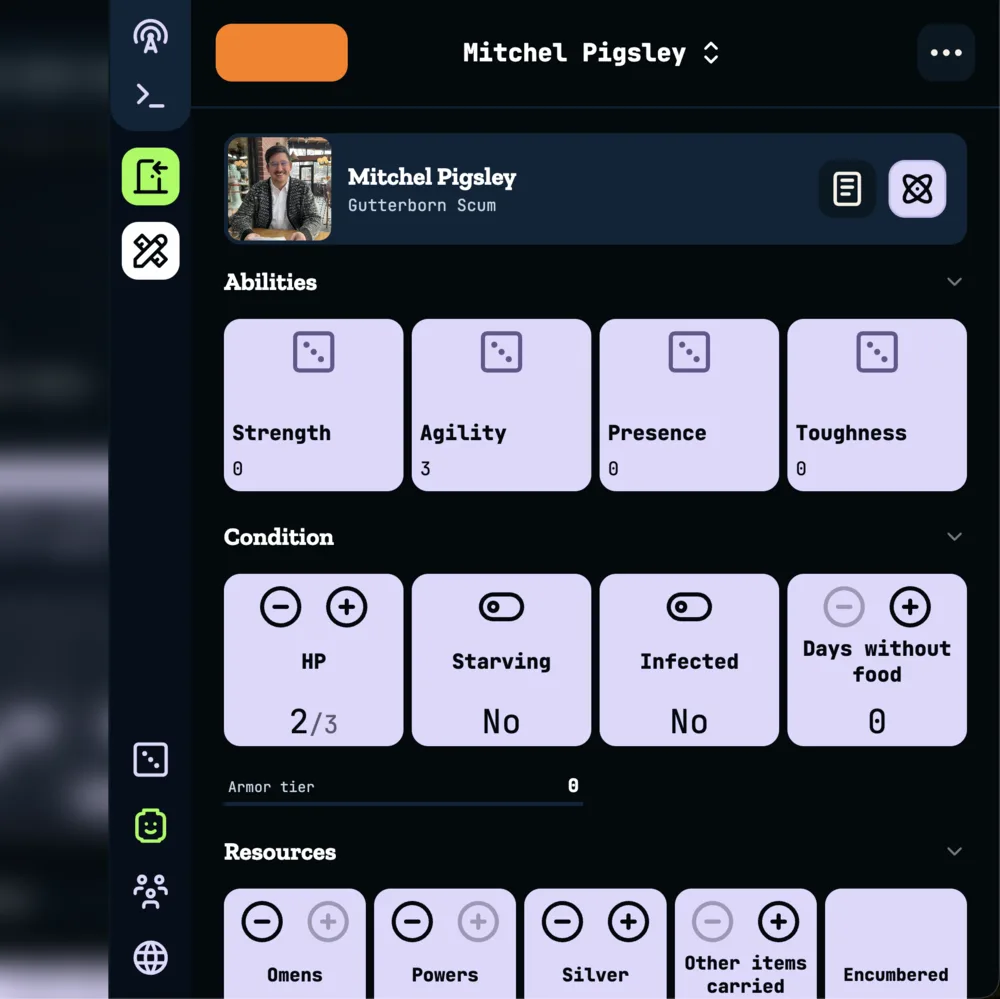
What the tiles do
- Rolls. Tap to roll, and the result shows with the bonuses spelled out. Long-press for the full roll, with situational modifiers tucked behind Show Modifiers.
- Hit points. Take Damage and Heal run the game's own rules, rolling armor or shield dice when they apply, so a hit the armor soaks still shows what happened.
- Counters and toggles. − and + for quick changes, type a number when you need to, and flip Starving or Infected with one tap.
- Gear. Add items from the game's lists, equip and unequip what you carry, and add homebrew items of your own.
The rules speak up when they need to
When the game calls for something, like a level-up or a roll at 0 HP, a banner appears on the sheet. Choices still waiting for an answer collect in one place instead of hiding in a corner of the sheet. And when you just want to fix a number, Edit Sheet lets you change values directly, remove entries, and drag lists into whatever order makes sense to you.
Character Sheets in a Shared Campaign
A sheet on its own is a page of numbers. What makes it worth keeping here is everything else the realm already knows about the character.
The character is a compendium entry
A player attaches a character from the compendium, or creates one on the spot, and the sheet belongs to that entry. So the same character has its relationships, its history, and every session where it was mentioned one click away from its hit points. How the compendium fills itself in as you play
Players show up as their characters
Each player marks one character as active, and across the realm they show up as that character: its name and its picture in the gamestream, the transcripts, chat, and notifications. Players with more than one character can flip between sheets without changing who they are playing tonight.
Private notes, and a sheet that stays yours
Every character has private notes one tap from its card, visible only to the player who wrote them. Each sheet lives in its player's own character panel, and nobody else at the table can change it.
Built on the Open Character Format
The sheets are powered by the Open Character Format (OCF), an open-source format we started for describing tabletop RPG characters and the rules that run them. A game pack spells out its stats, choices, rolls, and gear, and the same engine plays any of them. That is why one sheet can roll MÖRK BORG armor dice and walk a Pathfinder player through their ancestry without either game being a special case.
The format is free for anyone to use. If you build tools, a virtual tabletop, or just think characters deserve better than a PDF, the spec and the packs are at opencharacterformat.org.
When a game's rules update
Each sheet remembers the exact version of the rules it was made with. When a pack releases a new version, the sheet moves to it on its own, and the player gets a short note at the top listing what changed, like a maximum going from 3 to 2. New choices an update adds wait for an answer without getting in the way of play.
What It Does Not Do Yet
Better to know before session zero:
- Six games, for now. Sheets exist for the games in the table above. Other systems still get everything else a realm does, but their players keep sheets elsewhere.
- No shared crew sheets yet. A Forged in the Dark crew sheet cannot be shared between players yet, and actions that need more than one character, like group actions, are left out until it can.
- No party view for the DM yet. Each player keeps their sheet in their own character panel. There is no screen yet where the DM sees the whole party's sheets side by side.
- Sheets are for player characters. NPCs and monsters in the compendium do not carry game stats.
- Not in the API, MCP server, or exports. Sheets are kept in the app. Compendium exports and the API cover the entities, relationships, notes, and quests around them.
- It is not a rulebook. Some packs carry only the mechanics, so keep the book around for descriptions and the parts of the game that are not numbers.
TTRPG Character Sheet FAQ
Are the character sheets free?
Yes. Character sheets are part of the free tier, along with the compendium, notes, quests, and dice. Coins only pay for AI features like transcription and recaps, and nothing on a sheet uses them.
Which games have character sheets?
D&D 5E from the System Reference Document 5.1, Pathfinder Second Edition under the ORC license, Forged in the Dark scoundrels and crews, Fate Core, MÖRK BORG, and Mothership. Every game is an Open Character Format pack, so more games can be added the same way.
How does the DM turn character sheets on?
Realm owners and admins pick the games under Character Packs in the Configure Realm panel. Once a realm has packs, each player opens the character panel, attaches their character, and starts a sheet with guided or random creation.
Is this a D&D Beyond replacement?
It covers the at-the-table basics: building a character, rolling, tracking hit points, and managing gear. It only includes the 5E rules from the free System Reference Document, though, so content from other books is not available. Players can add homebrew items of their own.
Can other players change my character sheet?
No. Each sheet lives in its player's own character panel, and only that player can change it. Each character's private notes are visible only to the player who wrote them.
What happens to my sheet when a game pack is updated?
It moves to the new rules automatically, and a note at the top of the sheet lists what changed. If an update adds a new choice, it waits for an answer without blocking play.
What is the Open Character Format?
An open-source format for describing tabletop RPG characters and the rules that run them, free for anyone to use. Realms of Shod uses it for every sheet. The spec and the game packs are at opencharacterformat.org.
Can I play a system that is not on the list?
Yes. Everything else in a realm, from transcripts and recaps to the compendium and quests, works with any system. Characters in a realm without packs open to their private notes instead of a sheet.
Roll Up a Character Tonight
Make a realm, add the game your table plays under Character Packs, and roll a random character to see how a sheet feels in play. It takes a couple of minutes, and creating an account is free.
The full walkthrough, from adding packs to editing a sheet, is in the character sheets documentation.