
"Wait, are we still supposed to be finding the miller's daughter?"
A D&D Quest Tracker for Every Thread Your Party Picks Up
A campaign accumulates promises. The party agrees to clear a mine, and then a courier hands them a sealed letter, and then the rogue quietly decides to find whoever burned down her village, and by session twelve nobody can say which of those is still live. Quests in Realms of Shod hold each of those threads as its own record: how it started, what counts as done, what was promised in return, and a timeline of everything that has happened to it since.
Most of that board fills itself in. As the scenes of a recorded session are saved, they are read for the threads the table is following, so a bounty taken in play shows up as a quest and the quests already running pick up steps as the story moves them. A quest is never marked done by hand either: its status is read back from the timeline every time the quest is opened, so the board and the campaign can't drift apart.
What a D&D Quest Record Holds
Most quest logs are a list of sentences, which is fine until the party has fourteen of them and half are phrased as questions. A quest here is built from three named parts instead, so two DMs writing the same quest end up with the same shape.
Hook
How the quest began and what drew the party in. The drunk guard who let something slip, the reward poster, the smoke on the horizon. This is the part players actually remember, which is why it is what the quest is listed under rather than a bare objective.
Goal
A short title for what has to be done, plus a description of how the table will know it is met. The description matters more than it sounds: "deal with the wolves" ends three different arguments depending on who you ask, and writing down what counts as done settles it while everyone is still agreeable.
Reward
What was promised, and the details of that promise. Optional, because plenty of quests get taken up for reasons that have nothing to do with payment, and a tracker that demands a gold figure for the paladin's crisis of conscience is a tracker nobody fills in.
Mechanic, Motive, and Source
Three optional tags describe a quest's shape without the DM having to write a paragraph about it. They show on the quest's document and give the compendium something to filter on, which is how you find the three open investigations when the party suddenly wants to do legwork.
| Answers | Values | |
|---|---|---|
| Mechanic | What kind of quest is it at the table? | fetch, deliver, escort, rescue, hunt, defend, investigate, explore, infiltrate, negotiate, sabotage, escape, heist, build, recruit |
| Motive | Why is the party doing it? | justice, vengeance, wealth, duty, survival, goodwill, loyalty, curiosity, glory, power, faith, redemption, coercion |
| Source | Where did it come from? | commission, request, order, rumor, discovery, crisis, backstory, self-directed, omen, consequence |
Each tag also has an "other" value for the quest that refuses to fit, and tags left blank simply don't appear.
The Step Timeline
Everything that happens to a quest is recorded as a step: a type, paired with a note about what happened. Steps stack in order into a timeline on the quest's document, so a quest read six months later is a short history of the party's involvement rather than a single stale sentence.
Seven of the step types move a quest forward without ending it.
| What it records | At the table | |
|---|---|---|
| Discovery | New information or a clue toward the goal comes to light. | The ledger names a second buyer nobody had heard of. |
| Milestone | A sub-goal on the way to the goal is achieved. | The party reaches the mine entrance alive. |
| Complication | A setback or twist makes the goal harder to reach. | The NPC who hired them has been arrested. |
| Clock tick | Time runs down, or the threat behind the goal grows. | A third village goes quiet overnight. |
| Encounter | A significant fight or confrontation happens toward the goal. | The fight on the bridge with the cult outriders. |
| Atmosphere | A mood-setting moment touches the quest without moving it. | The miller leaves a lamp burning in the window again. |
| Decision | The party commits to how they will pursue the goal. | They choose to bargain with the coven rather than burn it out. |
Three more step types end a quest: completed, failed, and abandoned. A quest can carry at most one ending step, and it has to be the last thing on the timeline.
Status Follows the Steps
A quest's status is never typed in. It is worked out from the timeline every time the quest is read, which means the board can't say "active" about something the party finished two sessions ago.
- Proposed — no steps yet. The quest exists; nothing has happened to it.
- Active — at least one step, and no ending step.
- Completed, failed, or abandoned — whichever ending step sits last on the timeline.
Any step can be edited or deleted afterwards, which is also how a premature ending gets undone: delete the ending step and the quest reopens, right back to where the timeline left it. The compendium's quest list groups by the same derived status, into Proposed, Active, and Ended.
Who Sees Which Quest
Half the quests a DM tracks are ones the party doesn't know about yet. The cult's actual plan is a quest. So is the thing the warlock's patron wants, which the rest of the table would very much like to know and shouldn't. Quests use the same access model as the rest of the compendium, so a hidden quest is a normal quest with the audience turned down.
Public to the realm
Every member of the realm sees it, including anyone who joins later. On a public realm this reaches signed-in guests and whatever audience the campaign has picked up.
Specific members
Turn public off and pick exactly who can see the quest. This is the setting behind every secret the table runs on: the rogue's debt, the letter only one player read, the deal made in a private session. The quest's creator always keeps their own access, so a DM can't lock themselves out of their own plot.
Reveal
When the party finally walks into it, Reveal Quest flips a quest public to the realm in one action from its menu, the same way an NPC or a location is revealed. Useful mid-session, when the reveal is the moment and nobody wants to watch the DM work through a permissions form.
Visibility is per quest, so a campaign can run an open quest board and still keep a drawer of things nobody has earned yet. Full quest documentation
Quests Sit Next to the Rest of the Campaign
Quests live in the Compendium alongside entities and notes rather than in a separate app, which is what makes them worth keeping. A quest is about people and places that already have their own records.
Linked entities
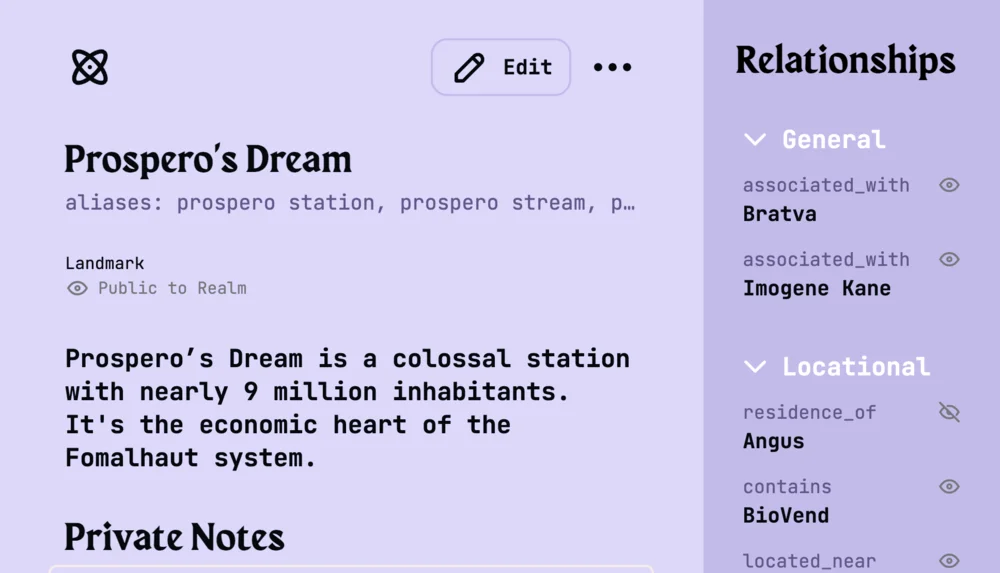
A quest can link any number of the entities involved: the merchant who hired the party, the ruined keep they have to reach, the amulet they are supposed to bring back. Linked entities appear grouped by type beside the quest, and each one is a path straight to its own record. Which means the NPC page answers "what did we agree to do for him, again?" without anyone leaving the screen.
Those entity records are the ones the session pipeline is already building as you play. How session recaps and the compendium fill themselves in
Quests show up in the Gamestream
Creating a quest, whether by hand, through the API, or through an import, drops a marker into the realm's Gamestream. The party sees a new quest enter play in the same feed where scene recaps appear, so the quest board updating is a visible beat rather than something the DM does silently between sessions.
Keeping the Quest Board Current
Every quest tracker dies the same death: it is a chore, so it goes stale, so nobody trusts it, so it stops being worth updating. The board here is mostly kept by the sessions themselves, with three other ways in when you want to steer it.
From the session, as it is recorded
As each scene of a recorded session is saved, it is read for the threads the table is following. A bounty taken, a promise made, a debt owed: each becomes a quest, and the quests already running pick up steps as scenes move them along, including the ending when the story finally gets there. A quest that was only offered sits as proposed until the party actually does something about it.
Only quests tied to entities present in the scene are considered, which is what keeps a quest from accruing steps about things happening three regions away. Extraction is a Coin feature charged to the session, the same as entity extraction and scene recaps. How a recorded session becomes recaps and compendium entries
By hand, for the quests only you know about
The villain's actual plan was never said out loud at the table, so nothing can extract it. Add a quest from the compendium and add steps as you like; a step is a type and one line of note, short enough to write while the party argues about marching order. Hand-written quests are free, and a tag you set yourself is never overwritten later.
Through the API or an AI assistant
Quests are fully available over the REST API with Bearer token authentication, and over the MCP server, where list_quests, get_quest, save_quest, delete_quest and quest_step are exposed to any assistant you connect. Quests API reference
From an import
Compendium exports carry quests in the V4 format, each with its hook, goal, reward, tags, linked entities, and full step timeline. Re-importing the same file updates the quests and steps already there instead of duplicating them, so a campaign kept in a spreadsheet or another tool can be brought over once and topped up later. Worth knowing for an existing campaign: only scenes saved after quest extraction launched get read, so the back catalogue is an import job rather than something that fills itself in.
D&D Quest Tracking FAQ
Does it pull quests out of the session recording on its own?
Yes. As each scene of a recorded session is saved, it is read for the threads your table is following. A hook that lands in play becomes a quest, and an existing quest picks up a new step, or an ending, when a scene moves it forward. A quest that was only offered starts as proposed; if the party is already acting on it in the scene where it came up, it starts active with its first step on the timeline.
Which quests does a scene get checked against?
Only the ones tied to characters, places, or other entities present in that scene, which keeps a quest from collecting steps about events on the other side of the map. A player character counts as present only when that player actually attended the session, so the rogue who missed a week does not quietly make progress on her own vendetta.
Does extraction overwrite what I wrote by hand?
No. Mechanic, motive, and source are filled in once, when the quest is created, and a tag you chose yourself is never overwritten. Steps are added to the timeline rather than rewritten over, so your notes and the extracted ones sit in the same history without competing.
What does automatic quest extraction cost?
It is a Coin feature charged to the session, the same way entity extraction and scene recaps are. Quests you create by hand, through the API, or from an import are free. Only scenes saved after quest extraction launched are processed, so older sessions in a long-running campaign are not backfilled.
How does a quest get marked complete?
You add an ending step to its timeline: completed, failed, or abandoned, with a note about how it landed. The status is then derived from the timeline rather than stored, so it always agrees with the last thing that actually happened. A quest can only carry one ending step, and it has to be last.
The party finished a quest and then it turned out they hadn't. Can I undo it?
Delete the ending step. The quest reopens, with every earlier step still in place, and goes back to active. That is the intended way to walk back a premature ending, which is why endings are steps rather than a switch somewhere.
Can I keep a quest hidden from the players?
Yes. Turn off Public to Realm and choose exactly which members can see it, or nobody but yourself. Villain plans, patron demands, and one player's private deal can all sit on the board next to the open quests without leaking. When the party walks into it, Reveal Quest makes it public to the whole realm in one action.
What happens to a quest the party just quietly stops caring about?
Abandoned is an ending in its own right, alongside completed and failed, so a thread that was dropped reads as dropped rather than sitting active forever. It stays in the compendium with its timeline intact, which matters when the NPC they left hanging shows up eleven sessions later with an opinion about it.
Does this work for systems other than D&D?
Yes. A quest here is a hook, a goal, an optional reward, and a timeline, none of which is a D&D rule. A Pathfinder adventure path, a Call of Cthulhu investigation, or a Blades in the Dark score all use the same record. D&D is simply where most tables run into an unmanageable pile of open threads first.
Can players add to a quest themselves?
Sharing a quest grants a player view access to it, so the board is something the table reads rather than edits. Writing quests and steps stays with the people who run the realm, which keeps the timeline a single account of what happened instead of six players' versions of it.
Start with the threads already open
The useful first pass is short: write down the three or four things your party currently believes they are doing, give each one a goal description specific enough to settle an argument, and mark the ones they have quietly abandoned as abandoned. That alone usually turns up a promise somebody made two months ago that everyone forgot about, which is the best possible way to open next session.
Creating an account is free, and a realm with quests in it costs nothing to keep. Bring the board up at the start of the night and let the party tell you which thread they are pulling.