
Your DM will read three sentences. Make them count.
D&D Backstory Questions: 40 Prompts for Players and DMs
A good backstory is not long. It is useful: a few facts that tell you how your character reacts, and a few loose threads your DM can pull. This page gives you 40 backstory questions sorted by what they are for, a quick guide to how many to answer, and advice on turning answers into hooks.
Then it asks why most backstories are written once, handed in at session zero, and never mentioned again.
The Quick Answer
| You are | Answer | Aim for |
|---|---|---|
| A new player | 5 questions from "The core" | One paragraph |
| An experienced player | The core, plus 3 hooks for your DM | Half a page at most |
| A DM prepping session zero | Pick 6 to 8 and send them ahead | Answers you can actually use |
| A DM mid-campaign | One warm-up question per session | A sentence per player |
Whatever you write, finish with at least one person who wants something from your character and one question your character cannot answer yet.
40 Backstory Questions by Purpose
The core: who they are right now
- What does your character want more than anything, and what are they doing about it?
- What would make them walk away from the party?
- What is one thing they believe that most people around them don't?
- How do they act when they are scared, and how is that different from how they act when they are angry?
- What do they do with the first free hour in a new town?
- What habit do the other characters notice within a day of meeting them?
- What do they carry that has no practical value?
- What would they never do, even to save their own life?
Where they came from
- Who raised them, and what is the one thing that person got right?
- What did their home smell like?
- What was the first time they were truly afraid?
- Who taught them the skill they rely on most, and are they still on good terms?
- What did they leave behind when they left home, and did they mean to?
- Is there a place they can never go back to? Why?
- What was the best meal they have ever eaten, and who made it?
- What did the people back home expect them to become?
Hooks for your DM
- Who is looking for your character right now, and why?
- Who does your character owe, and how much?
- What promise have they made that they have not kept yet?
- What rumor about them is untrue, and who started it?
- Which organization would pay to know where they are?
- What question about their past do they not know the answer to?
- Who would they drop everything to help?
- What object from their past is still out there in the world?
Connections to the party
- Which party member do they trust most after one week, and why that one?
- What do they assume about the party's wizard that is probably wrong?
- What could another party member do that would hurt them deeply?
- Have they met anyone in the party before, even briefly?
- What would they do if the party's leader made a bad call?
- What would they want the party to say about them if they died?
Warm-ups for mid-campaign
These work well as a single question asked at the top of a session, a practice many GM bloggers recommend because the characters spend far more time together than the players do.
- What did your character dream about last night?
- What have they been doing with their share of the treasure?
- What is the last thing that made them laugh?
- What have they learned about the party that surprised them?
- What would they write in a letter home tonight?
- Which NPC do they think about more than they would admit?
- What has changed about them since the campaign began?
- What small thing are they afraid the party will find out?
- Where would they go if the adventure ended tomorrow?
- What question do they wish someone would ask them?
How to Use the Answers
For players
Pick the answers that change how you play. “Grew up in a fishing village” is set dressing. “Can't swim and hides it” changes what you do on a boat. Keep the rest as private color. Leave gaps. A backstory that already resolved its own arc gives the DM nowhere to go.
For DMs
Read for hooks, not biography. Circle every named person, every debt, every unanswered question. Those become NPCs, rumors, and side quests. Tell the player which thread you picked up, or let them discover it in play. Both work.
If you want dice to decide
Xanathar's Guide to Everything includes tables for generating a character's origins, siblings, and life events at random. They are a good starting point when a player stares at a blank page, and the results often produce stranger, better backstories than anyone would have chosen.
Why Players Search This
You searched this because a blank “backstory” box is intimidating, or because you are a DM who wants your players' characters to matter to the story. Both are good reasons. The frustration underneath is familiar: players worry about writing too much or too little, and DMs worry about receiving three pages they will never have time to use.
Backstory Is Written Once. Characters Keep Changing.
Most backstory advice treats it as a pre-game deliverable. Answer the questions, hand it in, start playing. The problem shows up around session ten.
| What a session zero backstory does well | What it can't do on its own |
|---|---|
| Give the DM hooks before play begins | Reflect who the character has become since |
| Help a player find a voice | Stay visible to the rest of the table |
| Seed NPCs and places | Connect to the NPCs and places that emerged in play |
| Hold secrets | Reveal a secret gradually, on the table's timing |
By the midpoint of a campaign, the backstory document is a snapshot of a person who no longer exists. The character has a rival they didn't have, a vow they made at a funeral, a fear they picked up in the Underdark. None of that is in the document. Meanwhile, the other players have never read it, so the best material in it never reaches the people who could react to it.
The DM becomes the only reader
A common complaint on DM forums runs both ways: players feel their backstories are ignored, and DMs feel buried under backstories they cannot weave in. The shared cause is structural. The backstory is a private letter from one player to one DM, and the DM is juggling five of them.
Backstory as Ongoing Discovery
The upgraded frame: treat backstory as something the table discovers over the course of the campaign, not a document delivered before it. Warm-up questions are an early version of this idea. Here are the traits that make it work, with or without software:
- Short at the start. A paragraph and two hooks at session zero. The rest is found in play.
- Written in moments, not at once. A small exploration every few sessions, prompted by what just happened.
- Visible to the party, when you want. Other players react to what they know. Sharing a memory is a roleplay act.
- Secrets that stay secret. Some answers belong only to the player and the DM, and the table should see only that something is hidden.
- Linked to the world. When the character remembers their mentor, the mentor becomes an NPC the DM can use, not a name buried on page three.
- Owned by the player. The DM curates the story, but the character's inner life belongs to the person playing them.
You can run this tonight with one warm-up question per session and a shared doc where players post their answers.
Where Realms of Shod Fits
Realms of Shod sits next to your session zero, not instead of it. Keep your questions. Add a way for backstory to keep unfolding in front of the party.
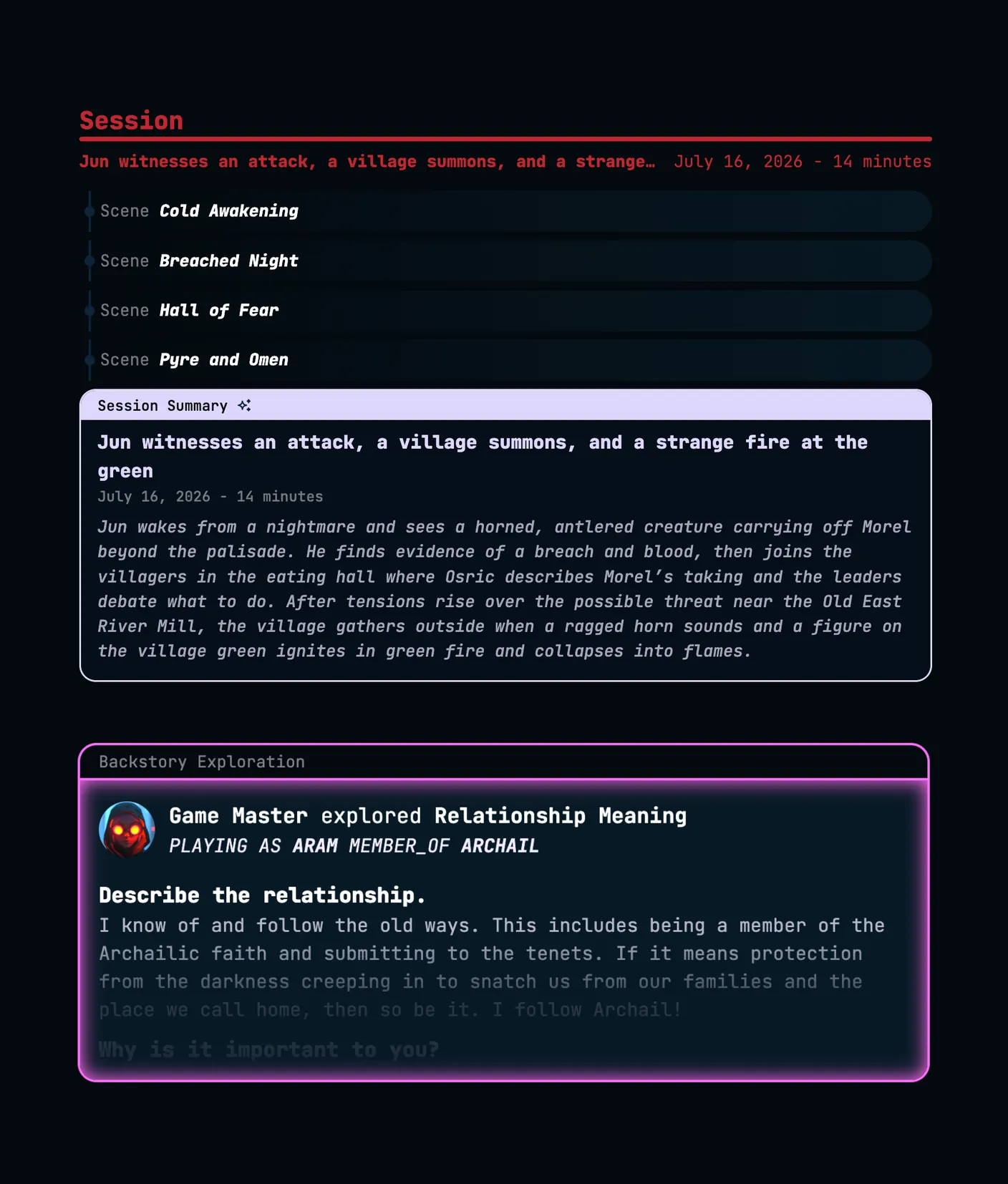
Backstory Exploration is a guided creative-writing exercise in a realm. Open it from Story Tools (available to Collaborators and above), pick a format, choose which character you are writing as, and answer a short series of prompts. When you publish, it appears in the Gamestream as its own card for the rest of the realm to read, separate from the session timeline.
If part of your past should stay hidden, publish it as a Shadow. Other members see an AI-rewritten Echo in place of your real answers, while you and the realm's admins and owner can still read the original. The party knows there is something there. They just don't know what. A Shadow costs a small fraction of a coin.
| Backstory document | Backstory Exploration |
|---|---|
| Written once, before play | Written any time, prompted by play |
| Read by the DM | Published to the party's Gamestream |
| Secrets live in a private message | Shadows show the party an Echo, not the truth |
| Names in the text stay text | Characters and places live in the compendium |
| Free | Shadows cost a small fraction of a coin |
- After a big session. The fighter who just lost her mentor writes what that mentor taught her.
- Between sessions. A quiet week becomes a chance for each player to add one memory. See what to do between sessions.
- When a player misses a game. They catch up through a rumor and add a backstory beat in the meantime. See when a player misses a session.
Backstory Questions FAQ
How long should a D&D backstory be?
For most tables, one paragraph to half a page. Ask your DM what they want. Short backstories with a few strong hooks are usually more useful than long histories.
How many backstory questions should I answer?
Five to eight is plenty to start. Answer the ones that change how you play, and leave room to discover the rest.
Should my backstory include secrets from the other players?
It can, if your table enjoys that. Agree on it at session zero. Some groups love hidden pasts; others prefer everything in the open so players can set up drama together.
What if my DM never uses my backstory?
Ask them directly which thread interests them, and offer one concrete hook: a person looking for you, or a debt you owe. If the campaign is a tight published adventure, there may be less room, and that is a fair answer.
Can I use AI to write my backstory?
You can, and plenty of players use it for a starting draft. Reviewers who tested chat assistants for this found the same weakness: stories that finish their own arc and leave the DM nothing to use. Edit toward open questions.
Do I need an app for backstory?
No. A notebook, a shared doc, and a warm-up question each session work well for many groups. A tool helps when you want backstory visible to the party, with some of it kept hidden.
Does Backstory Exploration work for games other than D&D?
Yes. Realms of Shod is system-agnostic, and the prompts are about your character, not a ruleset.
Write Less at Session Zero. Discover More in Play.
The best backstories are not finished before the first roll. They grow out of what the character lives through, told to people who care what happens to them. Answer a few questions now, keep a few secrets, and let the rest arrive at the table.
A realm is free to start, and signing up comes with enough coins to try a Shadow on the first secret worth keeping.