
The empty chair is a recurring encounter.
What to Do When a Player Misses a D&D Session
It is 4 p.m. on game day and the group chat lights up: the rogue has a work thing. You have a dungeon half explored, an encounter built for five, and four people who still want to play. This page gives you the seven common ways to handle an absent player, a table for choosing between them in thirty seconds, and the ground rules almost every experienced DM agrees on.
Most advice stops when the session ends. The harder moment comes a week later, when the rogue sits back down and asks, “So what did I miss?” We will get to that too.
The Quick Answer
| Your situation tonight | Best option |
|---|---|
| Mid-dungeon, combat likely | Put the character on autopilot |
| In town, between arcs, or traveling | Write the character out for the night |
| The absent player trusts the table | Hand the character to another player |
| The character's absence fits the story | Turn the absence into a hook |
| Closed campaign, below your quorum | Cancel, or run a one-shot instead |
| The absent player wants to stay involved | Run a short solo scene with them later |
| Absences happen almost every week | Move toward an open table |
Whichever you pick, the best version is the one your group agreed on before anyone cancelled.
Seven Ways to Handle an Absent Player
| Option | Best for | Watch out for | DM effort |
|---|---|---|---|
| Autopilot | Combat-heavy nights | Making choices the player would hate | Low |
| Write them out | Towns, travel, downtime | Mid-dungeon logic gets strained | Low |
| Another player runs them | Trusting, long-running groups | Consent, and who takes the blame for a bad roll | Low |
| Absence as a hook | Mystery and intrigue games | Taking agency from the absent player | Medium |
| Cancel or one-shot | Closed campaigns with tight arcs | Losing momentum if it happens often | Medium |
| Solo side scene | Players who hate missing out | Your extra prep time | High |
| Open table | Groups that can never schedule | Tighter, secret-heavy stories get harder | High, up front |
1. Put the character on autopilot
The character follows the party, takes simple actions in combat, and makes no story decisions. This is the default for a reason: your encounters were built for the full party, and a missing healer can turn a fair fight into a slog. Keep it boring on purpose. No speeches, no deals with devils, no spending their gold. Advice on this has converged over the years: the player should return to a character in roughly the state they left it.
2. Write the character out for the night
The paladin has temple business. The wizard is buried in a library. In a city or on the road, a one-line excuse costs nothing and nobody asks follow-up questions. It gets awkward mid-dungeon, where “the ranger wandered off” strains belief. Some DMs keep a small table of excuses ready. Others use a recurring NPC who borrows absent heroes for errands, which is silly in exactly the way most tables enjoy.
3. Hand the character to another player
If the absent player agrees, someone at the table runs their character. It keeps the party whole and needs no explanation in the fiction. It also requires real trust, because the stand-in will face choices the owner would have made differently. Ask the absent player first, every time, and agree on limits: no major story decisions, no spending signature resources, and no romance with the vampire.
4. Turn the absence into a hook
The character vanished in the night, and the party wakes to a struggle in their room and a trail leading somewhere dangerous. Handled well, the missing player returns as the center of the next scene instead of a footnote. Justin Alexander has described doing a version of this at his own table, having a character slip out early to explain an unplanned absence. The line to respect: put the character in a situation, never make choices on the player's behalf.
5. Cancel, or run a one-shot instead
Some DMs simply do not run a closed campaign session unless everyone is present. Alexander holds this position for his closed games, and it protects campaigns built around individual arcs and secrets. The cost is momentum. If the table loses one game a month to scheduling, a standing backup one-shot keeps the night alive without advancing the main story. Agree on a quorum ahead of time so nobody has to make the call at 4 p.m.
6. Run a short solo scene with the absent player
A DM on the D&D Beyond forums described running a quick one-player scene over the phone to find out what an absent character got up to, which then became material for the next group session. It is generous and it produces great in-party roleplay. It also costs you time you may not have. Save it for players who clearly want it, and keep it to fifteen minutes.
7. Move toward an open table
If absences are constant, the problem may be structural. Open tables let whoever shows up play, with self-contained sessions in a shared world. Alexander has argued that anyone who loves playing should keep an open table in their back pocket, while acknowledging that some tight, secret-heavy campaigns do not survive the format. West Marches style games are the best known example.
Ground rules nearly everyone agrees on
- Never kill an absent player's character. If the dice turn, the character is knocked out and stabilized.
- Return the character as it left. Same hit points, roughly the same resources, same relationships.
- Talk privately about repeated absences. A direct message, not a callout in the group chat.
- Decide the policy at session zero. The rule you agreed on beforehand is the one nobody argues with.
Why This Question Keeps Coming Back
You searched this because a campaign is a promise four or five adults made to each other about their evenings, and adult evenings are unreliable. Nobody did anything wrong. The frustration is that every option above feels like a compromise, and the absent player comes back to a story that moved without them. That feeling is worth taking seriously, because it is the reason people drift away from campaigns they loved.
Tonight Is the Easy Half
Every option above answers one question: where is the character tonight? That matters, but it is the easy half. The harder half arrives at the start of the next session.
| What the seven options solve | What they leave open |
|---|---|
| Where the character is tonight | What the player knows next week |
| Encounter balance | Which secrets the character could plausibly have heard |
| Fairness with XP and loot | Who retells the session, and how accurately |
| The schedule | Whether the DM's memory is the only record |
The usual fix is a verbal recap at the top of the next game. Someone who was there summarizes, the story gets retold with a few mistakes, and twenty minutes of play time go to reconstruction. Worse, the full retelling hands the absent player everything: the lich's bargain their character never heard, the betrayal their character never saw.
The full recap is the wrong gift
A complete transcript or a thorough recap feels generous, and for many tables it is exactly right. But in a game built on secrets, it collapses the difference between what the player knows and what the character knows. The absent rogue now metagames around a twist she should have discovered in the fiction. The table did her a favor and took something from her at the same time.
Catch-Up as an In-World Act
The better frame: a returning player's character should learn what that character could plausibly have heard, told in the voice of the world. Not a transcript. Hearsay. This is old technology. Sandbox games have long used rumors in town as the way adventurers learn what happened while they were elsewhere, and the West Marches tradition leans on that idea for a reason.
You can run this with nothing but a notebook. Before the next session, write three lines of gossip the absent character might pick up at breakfast, and hand them over. A few principles make it work:
- Filter by character, not by player. Ask what this specific person, in this specific place, could have heard. A priest hears temple news. A rogue hears the docks.
- Speak in the world's voice. A barmaid's version, a letter from a party member, a sending stone message. Hearsay can be wrong, which makes it more interesting.
- Keep it short. Three or four sentences. The point is orientation, not completeness.
- Leave the questions for play. The returning character can ask the party what happened, in character, which is itself good roleplay.
- Keep an honest record somewhere. Rumors work only if the DM still has the full truth to check against.
- Grant full access on purpose. Some tables want everyone fully caught up. That is a valid choice, made deliberately rather than by default.
This works whether or not you ever touch software. It turns an absence into a small piece of the fiction instead of a gap in it.
Where Realms of Shod Fits
Realms of Shod sits next to your absence policy, not instead of it. You still decide whether the rogue goes on autopilot or gets kidnapped. What changes is the return.
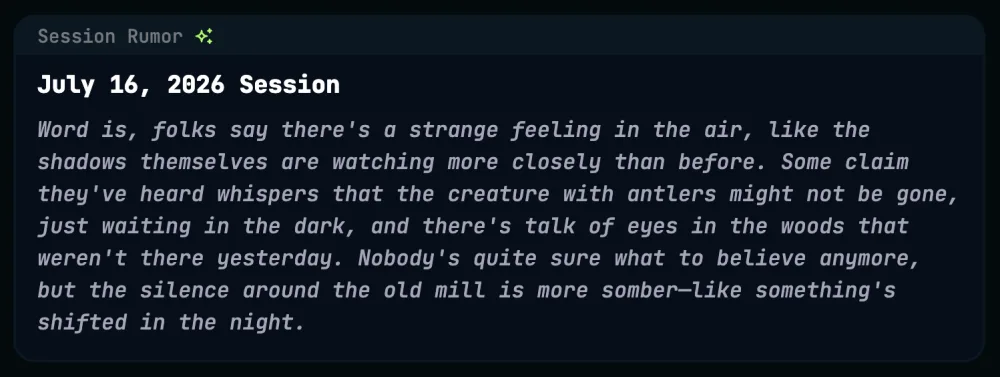
When a session is recorded in a realm, anyone who was not in that session sees a session rumor in place of its summary and transcripts: a short piece of in-world hearsay that hints at what happened without confirming who did what, where, or how it ended. The setting is on by default. Session participants, realm admins, and the owner always see everything, so the Gamelord (our word for GMs) keeps the full record. If a player should get the whole story, grant them that session from its edit form, or switch rumors off for the realm.
| Catch-up written by the DM | Session rumors in Realms of Shod |
|---|---|
| DM writes three lines before next game | Rumor is written from the session automatically |
| Full record lives in the DM's notes | Full transcript, scene recaps, and summary stay available to participants |
| Access decided in the moment | Access set per session or for the whole realm |
| Free | Recording uses coins, roughly 130 per hour of audio |
One honest note from the docs: rumors are written from the whole session, including hidden compendium entities. They are designed to stay vague, but if a secret truly matters, read the rumor before your players do.
- Online groups start recording with the Discord transcription bot, so the rumor exists before the absent player wakes up.
- In-person groups record on a phone and upload afterward. The same session recaps and rumors come out.
- Overloaded DMs stop writing catch-up notes by hand, which is one small weight off the pile.
Absent Player FAQ
Should an absent player still get XP?
Many tables have moved to milestone leveling, which removes the question entirely. If you use XP, a common middle ground is giving absent players the same amount as the lowest earner who was present. Pick a rule and apply it every time. Consistency matters more than the exact number.
Should I cancel if one player can't make it?
It depends on the campaign. Arc-driven games with personal secrets often suffer when a key player misses a reveal, and some DMs cancel for that reason. Episodic or sandbox games usually run fine. Set a quorum at session zero so the decision is already made.
Can another player control the absent character?
Yes, with the absent player's explicit permission and agreed limits. Keep that character away from major decisions, and never let them die while their player is gone.
What if the same player keeps missing?
Talk to them privately. Their schedule may have changed, or the campaign may not be working for them. Moving the game night, trying an open table, or letting them step back gracefully are all better outcomes than slow resentment.
Do I need a tool to catch absent players up?
No. A DM-written note with three lines of in-world gossip does the job well, costs nothing, and many excellent tables run that way for years. A tool helps when you want the rumor written for you and a searchable record behind it.
Can a player who missed a session read the full transcript in Realms of Shod?
Only if you allow it. By default they see the session rumor. The realm owner or an admin can grant access to a specific session, or turn rumors off for the whole realm.
Does this work for in-person tables?
Yes. Record the session on a phone, upload it afterward, and the transcript, recaps, summary, and rumor are produced the same way as a live online session.
How much does recording a session cost?
Creating an account is free and includes 100 signup coins. Transcription runs roughly 130 coins per hour, and the cost splits across participants who have coins.
Hold the Chair. Keep the Story.
Absences are not a failure of commitment. They are what happens when adults keep a campaign going for years. Pick your rule at session zero, protect the absent character, and give the returning player a way back into the fiction that feels like part of the game. The empty chair is only a problem when the story forgets whose it is.
Creating an account is free and comes with starter coins. See pricing for plans and coin packs.