
The wiki everyone wanted. Write it yourself, or let the session write it.
A D&D Campaign Wiki That Fills Itself In
Every group eventually tries to build one. A page per NPC, a page per town, a page for the faction nobody can remember the name of. It works for about five weeks. Then a session runs long, nobody writes it up, and the wiki quietly becomes a record of the early campaign only.
Realms of Shod calls its wiki the compendium, and it is built out of recorded play rather than homework. While a session is being transcribed, the named things in it are pulled out and filed: people, places, factions, objects, the events everyone is going to keep referring to. By the time you stop talking, the entries are already there.
It is also, underneath that, an ordinary place to write. Some people want the wiki to appear on its own; some people came to this hobby because they like writing the entry for the ruined lighthouse. Both are first-class here. You can hand-build a realm that never records a session, let the recording do the filing and never touch a field, or mix the two, which is what most tables end up doing. What follows is what gets filed, what you can write yourself, how it stays straight, and who is allowed to read it.
The Quick Answer
| You want | How the compendium handles it |
|---|---|
| Pages for the people and places | Filed from the recording, across 58 entity types |
| To stop writing it up afterwards | Extraction runs during the session, not after it |
| One entry per person, not three | Variants catch nicknames; duplicates can be merged |
| To write it yourself | A full editor: entries, connections, notes, and quests by hand |
| To know who serves whom | Typed relationships, shown from both ends |
| Somewhere to keep your own theories | A private notes field per member, per entity |
| Secrets the party has not earned yet | Access granted per entry, not by role |
| Your data back out | JSON export of the whole compendium |
The short version: it is a wiki you can write by hand, whose first draft happens to be a side effect of playing.
Why Campaign Wikis Go Stale
It is never the writing that kills them. It is the gap between the session and the write-up. You finish at eleven on a Thursday, you tell yourself you will do it Saturday, and by Saturday the only thing you can still picture clearly is the bit where the wizard set the boat on fire. The innkeeper who quietly refused to name his supplier is gone.
So the wiki records the parts of the campaign somebody had energy for. The first three sessions are immaculate. Session nineteen does not exist. And because the gaps are invisible, nobody notices the thing has stopped being a reference until the night they actually need it and it is not there.
Plenty of people do keep up with it, and enjoy it, and their wikis are better than anything a machine will write. But enjoying the writing and having the time for it are different problems, and it is the second one that empties these things out. So the fix is not more discipline. It is removing the gap: catching names while they are being said, when nobody has to remember anything yet, and leaving the writing to whoever wants to do it.
What Gets Filed
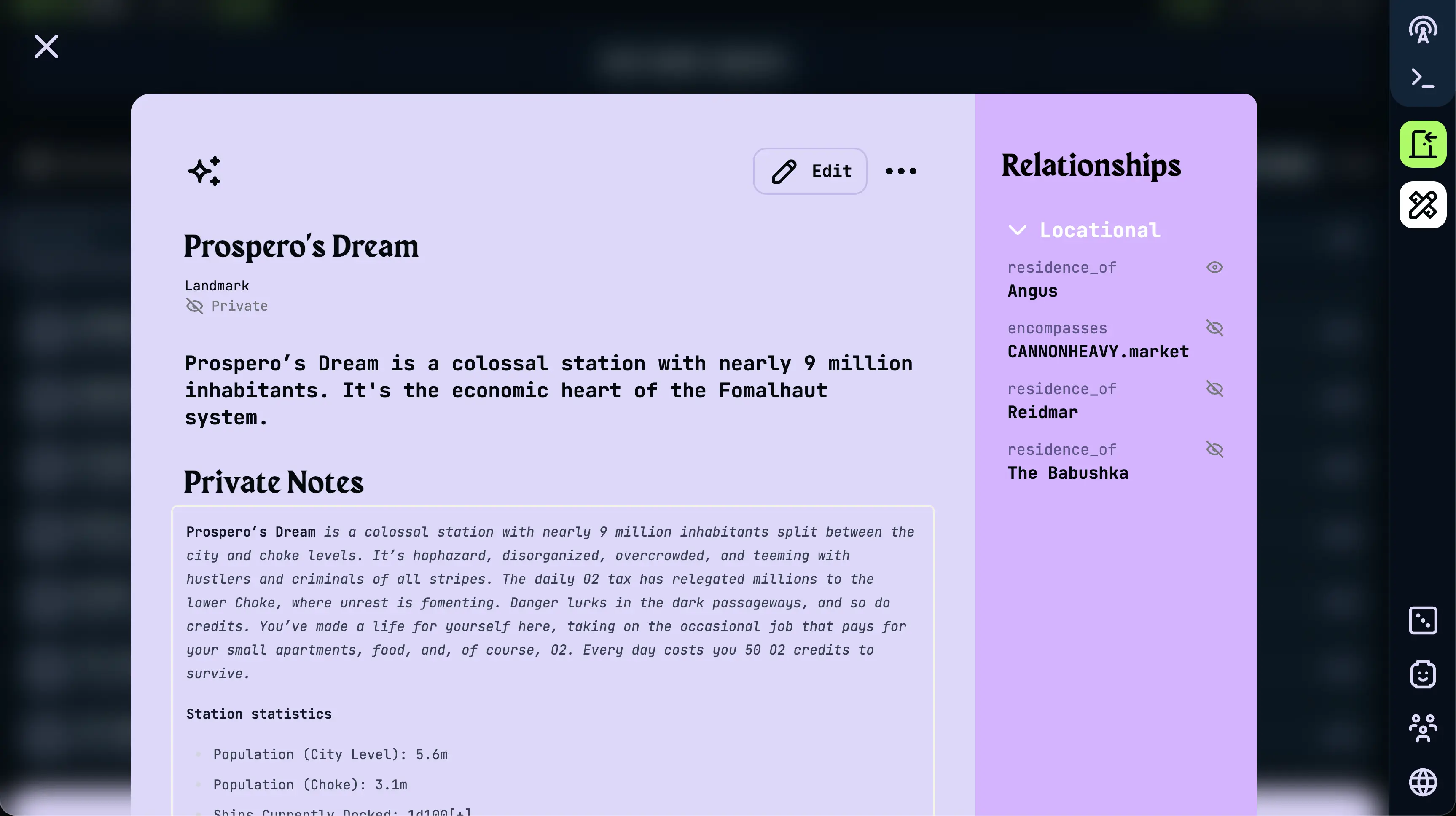
An entry is called an entity, and every entity has a type. There are 58 of them, grouped into seven categories, which sounds like bureaucracy until you notice what it buys you: the compendium can be filtered down to just the factions, or just the places, at the moment a player asks who else wanted that contract.
| Category | What lands in it |
|---|---|
| Character | Named people, creatures, species, and peoples |
| Location | Cities, regions, landmarks, rivers, ruins |
| Organization | Factions, guilds, cults, armies, dynasties, businesses |
| Establishment | Shops, temples, archives, treasuries, healing houses |
| Item | Weapons, relics, heirlooms, spells, ordinary gear |
| Event | Battles, disasters, festivals, treaties |
| Misc | Ships, letters, currencies, laws, technologies |
Entries arrive with a description drawn from how the thing was actually described at the table, which is worth a read before you rely on it. Extraction is good at catching that a name matters and roughly what it is. It is not a substitute for you deciding what the blacksmith is really up to. Every entry is editable, every field is yours, and the whole compendium searches with Cmd+F from anywhere in the realm. Which brings us to the other half of this.
Or Write The Whole Thing Yourself
Extraction is one door in. It is not the only one, and for a lot of people it is not the interesting one. Deciding what a place is for, naming the thing properly, writing the two sentences that make an NPC worth meeting again: that is the good part of running a game, and nothing here is trying to take it off you.
So the compendium is a full editor before it is anything clever. Every field extraction touches, you can touch. Everything it makes, you can make from scratch, and a realm that never records a single session is a perfectly ordinary way to use this.
| What you want | How you make it |
|---|---|
| An entry | Name, type, description, alternate names, images, and who can see it |
| A connection | Point any entry at any other and say what kind of tie it is |
| A note | A Markdown document of your own, kept private or handed to whoever you choose |
| A quest | A hook, a goal, an optional reward, and a timeline you add to as it unfolds |
| A link in your text | Type two brackets, pick the entry, or invent one on the spot |
| A world you already wrote | JSON import brings an existing compendium in whole |
Writing a stack of entries in one sitting is expected rather than tolerated: the form has a create-more box that keeps it open so a pantheon or a guild roster goes in one after another. Notes save a few seconds after you stop typing, with a line telling you where the sync got to. And while you are writing anything, typing two brackets pulls up the compendium to link a name, or creates the entry then and there if the innkeeper you just invented does not have one yet.
Nothing rewrites your sentences behind you
This is the part that matters if you like doing it yourself. An entry you wrote stays the way you wrote it. When later sessions have moved past what it says, you can ask for a resync on that one entry: it reads the mentions since the last sync, reconciles them with what is already there, and hands the result back as a draft in a text box. Edit it, accept it, or close the panel and keep what you had. The machine proposes. You are the one who saves.
Which is really the whole arrangement. Record and let the room fill the record in, write every word of it yourself, or do what most tables settle into: let the transcript catch the names and the spellings and the who-was-in-the-room, and spend your own evening on the handful of sentences that needed a person to write them.
One Person, Three Spellings
This is the failure that ruins hand-built wikis. The GM invents Gherri. One player says Gharri all campaign. Somebody writes Gerry in the notes. Three pages, one man, and no way to tell from any of them what he has already agreed to.
Variants: the nicknames come along too
An entity can hold alternate names, called variants, and matching runs against all of them. Longer names win, so Thornwall Keep resolves to the keep rather than the family it was named after. A name that gets mispronounced every week can be stored as a variant that points at the right record while still displaying the spoken form in the transcript, because the inline link keeps the canonical name and the shown text separate. Ordinary words are blocked from becoming variants, along with table vocabulary like roll and attack, so the record does not fill up with false matches on dice talk.
Merging: for when it happens anyway
Duplicates still turn up, usually because a character was introduced by title in one session and by name in another. Select the records, pick the one that survives, and choose whether its notes, relationships, and access lists come along. Variants and every reference in past transcripts are repointed at the surviving entry, so the old links keep working instead of quietly going nowhere.
Relationships and Private Notes
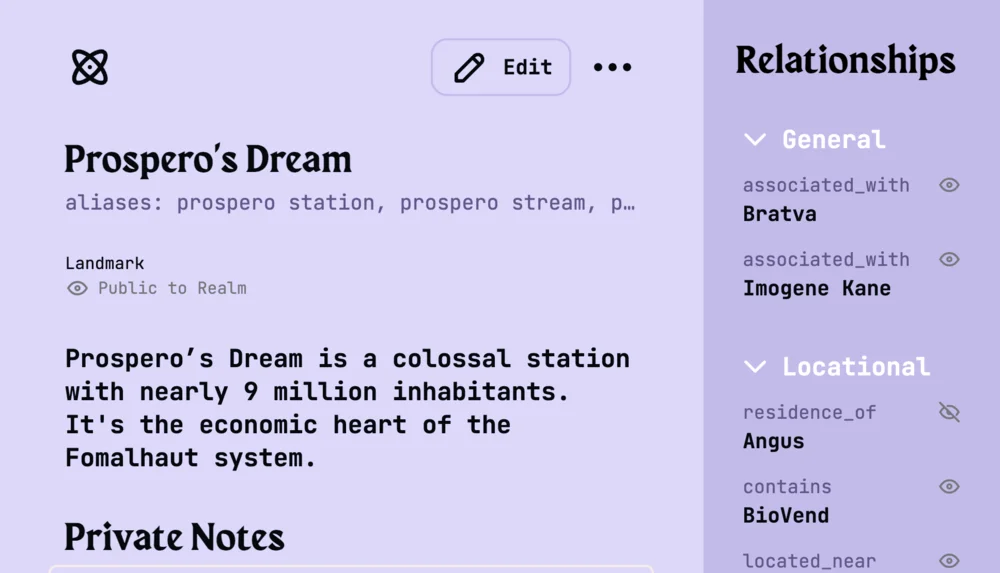
A wiki made of unconnected pages is just a list. What makes a campaign record useful at the table is the second question: fine, but who does he answer to? Entries are joined by typed edges, so the captain serves the throne and the throne governs the province, and each of those is a specific claim rather than a paragraph somebody has to reread.
| Family | Edges it covers |
|---|---|
| Organizational | Member of, affiliated with, governs, regulated by |
| Locational | Resides in, found in, operates within, travels to |
| Social | Ally of, enemy of, competes with, trades with |
| Employment | Employs, serves, leads, commands |
| Ownership | Owns, possesses, has |
| Commerce | Creates, purchases, accepts |
Edges have a direction, but you never have to think about which end you are standing on. Open either entry and the connection is listed there, stated the right way round. Some are inferred from play as sessions are transcribed. The rest you draw yourself, from the entry panel, picking the other end and the kind of tie, and those are usually the better ones: the thing a player worked out, the allegiance you decided on in the shower, the connection the recording had no way of hearing.
The notes field nobody else can read
Every member gets their own notes on every entry, and they stay private no matter how widely the entry itself is shared. This is where the paladin's player parks a suspicion about the quartermaster, and where a GM keeps the sentence explaining what the mask is for. Two people can hold contradictory theories about the same character without either of them leaking, which is closer to how a campaign actually works than one shared page pretending to be the truth.
Who Can Read Which Entry
A campaign wiki has a problem an ordinary wiki does not: half of it is supposed to be secret, and which half changes every week. Most groups solve this by keeping two wikis, a public one and the GM's real one, and then spend the campaign copying things from the second into the first.
Here, access is a property of each entry and each relationship rather than a role you hold. Anyone without access does not see a locked page; they see nothing at all, and have no reason to ask what they are missing. That applies to everyone, the realm's creator included, who simply tends to have access to most of it because they were in the sessions that produced it.
Revealing is the ordinary move. Make an entry public to the realm and every member has it, including people who join in month nine. Reveal one character's connections in a single action once their allegiances stop being a secret. Or hand a single entry to a single player, which is how one character learns the name of the buyer and the rest of the party finds out when she decides to tell them. When a session mentions something still hidden, the realm's creator gets a notification with a one-click reveal attached, so the record catches up with the fiction on the night it changed.
If you take a realm public, entries marked public to the realm are what signed-in guests and your audience can see. Everything else stays where you put it. The session rumor that goes out to absent members follows the same logic from the other direction: it is written to carry news without carrying the entries.
Against Notion, Obsidian, and World Anvil
These are good tools and this is not a case for abandoning one you like. The distinction worth drawing is not whether you can write in it, because you can write in all of them, this one included. It is whether anything shows up when you do not. Notion and Obsidian are better blank pages than the compendium is, and they stay blank.
| Tool | Where it wins | What it still wants from you |
|---|---|---|
| Notion | Databases, templates, and a team already living in it | Somebody to type every page after every session |
| Obsidian | Local files, backlinks, and a graph you own outright | The same writing, plus the linking, by hand |
| World Anvil | Deep worldbuilding templates and a huge community | Prep written up front; play does not feed it |
| A shared doc | Nothing to learn, everyone already has it | One volunteer, forever, with no way to find anything |
| The compendium | A full editor, plus entries and links made during play | A read-through, and your judgement on what it means |
If your worldbuilding happens months before anyone rolls a die, a dedicated worldbuilding tool is the right home for it, and a compendium you fill in by hand is a fair alternative rather than a compromise. If most of your world gets invented at the table, in the moment, by six people talking over each other, then the recording is where your setting actually lives and the wiki should be built from that. Most campaigns are some of both, which is the case for a tool that does both.
What It Does Not Do
Worth knowing before you move a campaign across:
- No map. Places get entries, not pins. Keep your map wherever it is now.
- Auto-filling needs recordings. A realm that never records starts empty and stays a hand-built wiki, which is a supported way to work, just not a self-writing one.
- Extraction is a first draft. It catches names and writes a serviceable description. It does not know which quiet detail you meant to matter.
- No public wiki theme. A public realm shows what you have marked public to the realm. It is not a skinnable published site.
Nothing here locks the door behind you either. The whole compendium exports to JSON, with relationships, notes, quests, and access lists included if you want them, and imports into another realm from the same file.
Campaign Wiki FAQ
What is a D&D campaign wiki?
A shared reference for one campaign: a page for each NPC, place, faction, and item, with the connections between them. It exists so a group can answer questions about its own world without anyone having to remember session six.
How do I make a campaign wiki without writing it myself?
Record your sessions into a tool that extracts named things as it transcribes. In Realms of Shod, the compendium is built while the session runs: people, places, factions, and items are filed with descriptions and connections, and you edit rather than author.
Can I build the campaign wiki by hand instead?
Yes, and it is a supported way to use it rather than a fallback. Entries, connections, notes, and quests can all be created and edited by hand, a realm that never records anything works fine, and an existing compendium can be imported from a JSON file. Extraction is one way in, not the only one.
What can the compendium hold?
Entries across 58 types in seven categories: characters, locations, organizations, establishments, items, events, and miscellaneous records like ships, letters, laws, and currencies.
What happens when the same character is written two ways?
Alternate spellings and nicknames are stored as variants on one entry, and longer names match first. If duplicate entries do get created, you can merge them: pick which record survives, choose whether notes, relationships, and access come along, and past transcript references are repointed automatically.
Can I keep secrets from my players in it?
Yes. Access is set per entry and per relationship rather than by role, and anyone without access sees nothing rather than a locked page. You can reveal an entry to the whole realm, to one player, or reveal all of a character’s relationships at once.
Can players write in the campaign wiki too?
Yes. Entries can be created and edited in the realm, collaborators can draw relationships between any two entries, and every member has a private notes field on every entry that nobody else can read, including the GM. Shareable Markdown notes and quests are written by hand as well.
Will it overwrite a description I wrote myself?
No. Descriptions are only updated when you ask for a resync on that entry, and even then the result comes back as a draft you can edit, accept, or discard. Nothing you wrote changes without you saving it.
Is it better than using Notion or Obsidian for D&D?
It is different. Notion and Obsidian are better blank pages and you own the files outright. Neither writes anything down for you. If your world is invented at the table rather than prepped in advance, a wiki built from the recording stays current and a hand-written one usually does not.
Can I get my campaign data out?
Yes. The compendium exports as a JSON file, optionally including relationships, notes, quests, and access lists, and that file imports into another realm.
Does the campaign wiki work for systems other than D&D?
Yes. Entity types and relationships are about fiction, not rules, so nothing in a compendium is tied to a ruleset.
A Wiki That Keeps Up Either Way
The test of a campaign record is not how good it looks in month one. It is whether, in month fourteen, somebody can say the name of a smuggler from last autumn and have the table know who they mean. That only happens if the record kept pace with the playing.
There are two honest ways to manage that, and this is built for both. Let the session file the names, the spellings, and the connections while you are busy running the game. Or sit down on a Sunday and write the place up properly, because that is the bit you love, with a real editor, your own notes, your own quests, and nothing rewriting a sentence you meant. Most people end up doing some of each, which is the point: the tedious half stops being your problem, and the half worth doing stays yours.
Realms of Shod is free to start. If you want to see what feeds the compendium first, the transcription page covers how sessions get recorded, and the session recap page covers what you read afterwards.