
What happens if the party does nothing?
How to Run a Living World Campaign
A living world is one that keeps moving when the players look away. The cult finishes its ritual. The rival company takes the contract. The town the party ignored has new walls, or no walls, when they come back. This guide compares the three engines GMs use to make that happen, gives you a weekly routine that takes about twenty minutes, and covers the mistakes that turn a living world into a GM's second job.
Then we look at the half of a living world most advice skips: not how the world moves, but how it remembers.
The Quick Answer
| You want | Use | Origin |
|---|---|---|
| Visible pressure at the table | Progress clocks | Blades in the Dark |
| Named steps toward doom | Fronts | Apocalypse World, Dungeon World |
| A map that changes between sessions | Faction turns | Worlds Without Number, among others |
| All three, lightly | Index cards with a goal, an enemy, and a clock | Common GM practice |
Whatever you choose, answer one question for every faction before session one: what happens if the players do nothing?
Three Engines, Compared
| Engine | How it works | Best for | Watch out for |
|---|---|---|---|
| Progress clocks | A circle split into 4 to 8 segments; fill one as a threat advances | Heists, dungeons, short arcs | Too many clocks and nobody tracks them |
| Fronts | A threat with a list of grim portents that happen in order unless stopped | Story-driven games with clear villains | Can feel scripted if portents never change |
| Faction turns | Each faction takes an action between sessions, resolved with a roll | Sandboxes and hexcrawls | Takes prep time, and results must reach players |
Progress clocks
Popularized by Blades in the Dark and now used across the hobby. Draw a circle, divide it, and fill segments as a danger approaches. Clocks can be visible, which puts pressure in front of the players, or hidden behind the screen for off-screen threats. Most GMs find 4 to 6 segments the sweet spot. They work in D&D with no rule changes at all.
Fronts
From Apocalypse World and its descendants like Dungeon World. A front is a threat plus a short list of “grim portents,” each a step toward its impending doom. If the players don't intervene, the next portent happens. Fronts give a sandbox a spine without dictating what the players do.
Faction turns
Games like Worlds Without Number formalize this: each faction has goals and assets, and between sessions it takes an action that can succeed or fail. The world changes on the map whether or not the party is involved. It is the most “simulation” of the three and the most rewarding in open-world play.
A Twenty-Minute Weekly Routine
- 1List three to five active factions. Each gets one index card: leader, want, enemy, and a clock.
- 2Advance one or two clocks. Base it on what the party did or didn't do. Roll if you want uncertainty.
- 3Write one consequence the players could notice. A closed road, a new price, a missing NPC.
- 4Decide how the news reaches them. A rumor at the inn, a letter, a wanted poster.
- 5Note what changed. Which NPC moved, which town changed hands, which promise came due.
- 6Stop. If it takes longer than twenty minutes, you have too many factions.
Common mistakes
- Peaceful factions. A faction with no conflict is a museum exhibit. Give every faction a current want and an obstacle.
- Invisible change. If the players never learn a faction moved, it didn't move for them.
- Everything at once. Constant emergencies exhaust players. Some weeks, a clock should tick quietly.
- Punishing absence of interest. The world should move, not punish the party for choosing a different thread.
The routine is deliberately small. A living world fails far more often from bookkeeping than from a lack of ideas.
Living Worlds Have a Long History
This idea is older than most of the tools. The RPGA's Living City campaign ran from 1987 to 2004, and Living Greyhawk from 2000 to 2008, sharing a single world across many tables. West Marches campaigns carried the idea into home games: many players, often several GMs, one persistent sandbox. Each of these ran into the same practical question at scale: who keeps track of what is true?
Why GMs Want This
You searched this because you want choices to matter. A world that reacts is the clearest way to tell players their decisions count. It also makes the GM's job more fun: the world surprises you too. The frustration is that living worlds have a reputation as a lot of work, and GMs who have tried one often remember the bookkeeping more than the magic.
A Moving World Needs a Memory
Clocks, fronts, and faction turns answer one question well: how does the world change? They answer a second question poorly: where does that change live?
| What world engines provide | What they leave to the GM |
|---|---|
| A reason for the world to change | Remembering every change that happened |
| Pressure and pacing | Keeping NPC descriptions current |
| Consequences for inaction | Telling each player what their character would know |
| Surprises for the GM | Reconciling what was said at the table with the cards |
| Structure between sessions | Sharing that state with other GMs or future players |
The engine advances a clock on an index card. But the world's actual state lives in forty places: the cards, the GM's notes, last session's improvisation, and what the players remember about the baron. After a year, the baron described in your notes and the baron the party has been dealing with are two different men. The world moved, and its record did not keep up.
Living worlds break at the handoff
This is sharpest with more than one table. When two GMs share a world, or a new player joins in month eight, the question is no longer “what happened?” It is “what does everyone agree happened, and who is allowed to know it?” Large living campaigns historically solved this with organizations, rulebooks, and volunteers. Most home games have none of those.
A World With Memory
The upgraded frame: a living world is two systems, an engine that moves it and a memory that records it. Most advice covers the first. The second decides whether the world feels alive in month twelve. A good world memory, built with any tools:
- Records what happened, not only what was planned. Prep says the cult wanted the bell tower. Play says the party burned it down first.
- Lets entities change over time. The baron is not one description. He is a history: promoted, disgraced, exiled.
- Treats relationships as state. Who serves whom, who owns what, who hates whom. Most world change is a relationship changing.
- Keeps secrets per viewer. The GM sees everything; each player sees what their character learned.
- Lets news travel as news. Players hear about distant change as rumors, which can be incomplete or wrong.
- Has a human gate on canon. Automation can propose updates. The GM decides what becomes true.
- Works across tables. If two groups share a world, both write into the same memory.
A low-tech version: one page per faction and major NPC, each with a dated “what changed” list at the bottom.
Where Realms of Shod Fits
Realms of Shod sits next to your world engine, not instead of it. It does not roll faction turns or fill clocks. Keep your cards. Use a realm as the world's memory.
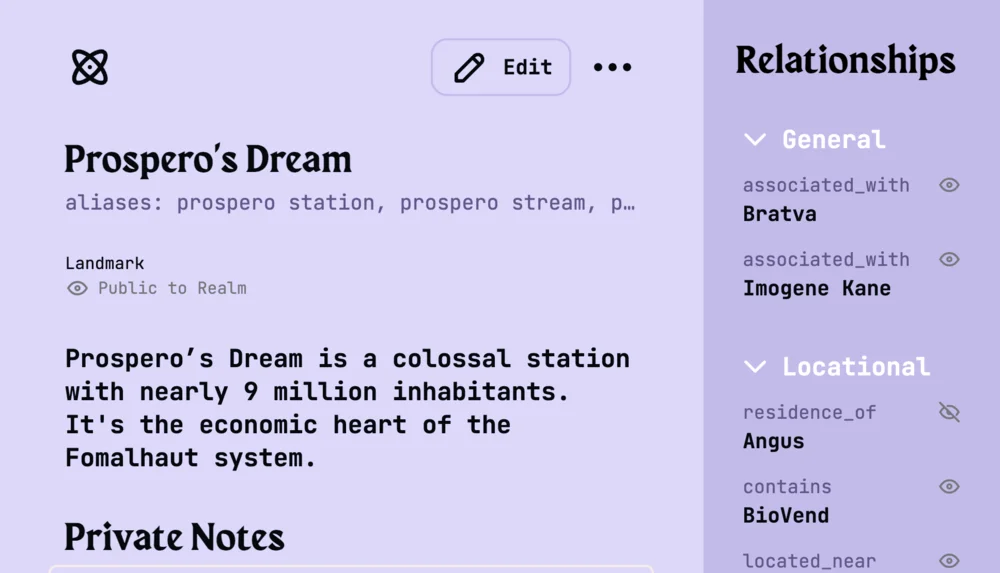
The compendium holds the world's entities: characters, locations, organizations, items, events, and establishments. When sessions are recorded, entities that come up in play are filed automatically and linked back to the moment they were mentioned. Relationships use 29 types across six categories, including organizational, locational, social, and ownership, so “the Ash Guild controls the docks” is a fact the world can hold.
Entities and relationships stay hidden until someone with the Collaborator role or above reveals them, so each player sees only what their character has learned. When the story changes an entity, description updates can be generated from transcript mentions and accepted by someone with permission, so the baron's entry keeps up with the baron. Players who miss a session hear about it as an in-world rumor.
For shared worlds, one realm supports up to 48 members, and multiple Gamelords (our word for GMs) can run separate campaigns in the same realm with a shared compendium and history.
Notes: where the world's paperwork lives
The one-page-per-faction habit described earlier has a home in the compendium. Notes are freeform markdown documents that sit beside entities on their own Notes tab, with their own names and their own access lists. Typing two square brackets inside one autocompletes from the compendium and drops in a linked chip, so a faction's page points at the guildmaster, the docks, and the rival it is moving against, and clicking any of them opens that entry.
Access is what makes them useful to a world in motion. A note is private to whoever wrote it until they share it, either with specific members or with the whole realm at once. So the cult's plan can be written the week you invent it, sit unread while its clock fills, and be revealed the session the party works it out. Viewers can read but not edit, and only the author can reveal a note, so the record never changes behind the Gamelord's back. Every entity also carries a private scratchpad note of its own, visible to nobody else at all, for the reminders that should never become canon.
Backstory Explorations: the world the players write
Faction turns move the world forward. Player writing gives it a past. Backstory Exploration is a guided writing exercise opened from Story Tools: pick a format, choose which character you are writing from the point of view of, and answer a short series of prompts. Publishing posts it to the Gamestream for the rest of the realm to read. A mentor, a home village, an old debt, all of it arrives as material the world can use, written by someone other than the GM.
That matters for a living world because a faction needs somewhere to push. The village a player invented is a village that can be taxed, burned, or defended, and the debt they wrote down is a lever an organization can pull. A piece of the past that should stay buried can be published as a Shadow instead, which shows the rest of the realm an AI-rewritten Echo while the author, the admins, and the owner keep the real text. The world holds the secret without the table being told it.
| World kept on cards and notes | World kept in a realm |
|---|---|
| Changes recorded when the GM remembers | Sessions recorded, entities linked from play |
| NPC descriptions go stale | Description updates proposed from what was said, approved by a person |
| Relationships live in the GM's head | 29 relationship types, revealed per player |
| One GM holds the truth | Several Gamelords share one compendium |
| News told by the GM | Rumors for players who weren't there |
| Faction pages sit in a folder outside the world | Notes in the compendium, linked to the entities they name |
| Prep is revealed by remembering to mention it | Notes shared per member, or with the realm, when you choose |
| Player backstory never becomes the world's | Backstory Explorations publish to the party; Shadows stay hidden |
Keep the engine in your preferred form, including cards, a spreadsheet, or a notes app. A private vault can be connected to a realm through MCP, so the notes you already keep and the world's record read from the same place.
Connect your notes with MCPLiving World FAQ
What is a living world campaign?
A campaign where the world changes on its own schedule, not only in response to the players. Factions pursue goals, time passes, and ignored problems get worse.
How do I make my D&D world feel alive?
Give every faction a goal and an obstacle, advance them between sessions, and make sure the players hear about the results. The last step is the one most GMs skip.
Should I use clocks, fronts, or faction turns?
Clocks for pressure the players can see, fronts for story-driven threats, faction turns for sandboxes where the map changes. Many GMs use a light mix.
How many factions should a living world have?
Three to five active ones. More factions can exist, but only a few should be moving at any time, or the bookkeeping takes over.
Is a living world too much work for a busy GM?
It can be. Index cards and a twenty-minute weekly routine keep it manageable. The expensive part is usually remembering changes, not inventing them, so a good record matters more than a clever engine.
Can Realms of Shod run faction turns for me?
No. It doesn't roll faction actions or track clocks. It records what happened in play, keeps entities and relationships current, and controls who sees what. Your engine stays yours.
Can two GMs share one world?
Yes. In Realms of Shod, multiple Gamelords can run separate campaigns in one realm with a shared compendium. Outside of software, a shared document with one page per faction is the simplest way to keep two GMs aligned.
Let the World Move. Let It Remember.
A living world is not the one with the most clocks. It is the one where the tavern the party burned down is still ash three months later, and everyone at the table knows it. Build a small engine, keep a faithful memory, and let consequences arrive as the world's own news.
Realms of Shod is free to start. If you want to see what the record looks like before you commit a world to it, read a real D&D session recap.