
Forty-eight people. Nobody has to be free on Thursday.
Shared World Campaigns: How a Group Becomes a Club
Most tabletop advice assumes one table: four to six people, one GM, one night a week. That shape is the reason most campaigns die, because it only takes two cancellations to stop everything.
There is another shape. One world, many small groups, several GMs, and everyone in the same membership. We call it a social sandbox, because it behaves less like a campaign and more like a club with a world at the center of it. This guide covers what that actually requires, why shared worlds historically needed a volunteer staff to survive, and what changes when the world can decide on its own who is allowed to know what.
The Quick Answer
| You want | What it looks like |
|---|---|
| A game that survives absences | Small groups play when they can; the world keeps its record |
| More than one GM | Anyone with the Collaborator role can run their own sessions |
| A world everyone shares | One compendium, written into by every group |
| No spoilers between groups | Non-participants get an in-world rumor, not the transcript |
| Members who contribute without a seat | Backstory Explorations, notes, and applause |
| Scale | Up to 48 members in one realm |
A shared world is not a bigger session. It is many small sessions that agree on a world.
Club, Not Campaign
The difference is who the thing belongs to. A campaign belongs to its party: five specific people and their arc. A club belongs to its members, and the story is whatever they collectively did this month.
That changes practical things:
- Attendance stops being a crisis. Six people free on Sunday is a session, not a quorum problem.
- Nobody is the only GM. Whoever wants to run something runs it, for whoever shows up.
- The world is the continuity, not the party. Characters come and go. The city they keep failing to fix is the throughline.
- Groups split and reform. Three members chase one thread while four chase another, and both are canon.
The tradition here is older than the software. West Marches games, open tables, and the big organized-play campaigns of the nineties all worked this way, and they worked well. They also all needed the same thing to survive.
Shared Worlds Break on Bookkeeping
Every large shared world eventually hits the same wall, and it is not creative.
| What a club structure gives you | What it demands back |
|---|---|
| A game that runs without everyone present | Someone tracking what is true across groups |
| Several GMs | Keeping those GMs consistent with each other |
| Many characters and threads | A record every member can actually read |
| Sessions you did not attend | A way to learn what happened without being spoiled |
| New members joining mid-story | An onboarding that is not two years of logs |
Historically the answer was labor. A wiki nobody updates. A lore-keeper who quits. A Discord with forty channels where the important post from March is unfindable. Organized play solved it with rulebooks and volunteer staff, which is not available to a group of friends.
The sharper version of the problem is visibility. In a shared world, “what happened” is not one answer. The group that fought the thing knows. The group across the map should have heard a version of it. A new member should know neither. Most tools give you exactly two settings, everything or nothing, and both are wrong.
Where Realms of Shod Fits
A realm holds up to 48 members. That is not a 48-person session, and it was never meant to be: live video is capped at 8 simultaneous streamers, because the realm is the club and a session is whatever subset of it is playing tonight.
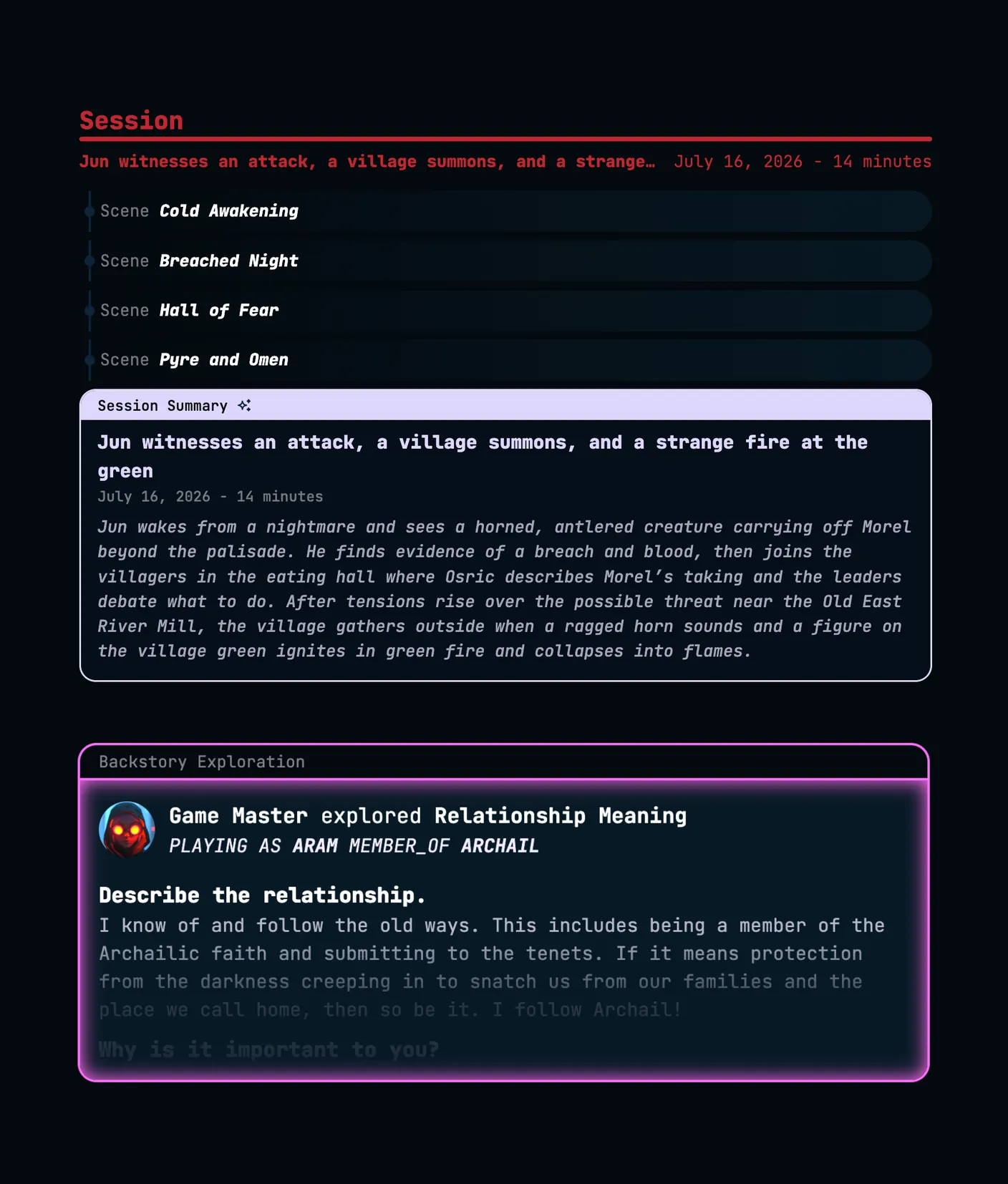
Many GMs, one world. Starting and ending sessions is a Collaborator permission, not an owner one, so several people can each run their own games in the same realm. They share the compendium: entities filed from recorded play, linked back to the moment they were mentioned, connected by 29 relationship types. What one group establishes, every group inherits.
Members add to the world between games. Backstory Exploration is a guided writing exercise opened from Story Tools: pick a format, choose which character you are writing as, answer a short series of prompts, and publish it to the Gamestream as its own card. Publish it as a Shadow instead and the rest of the realm sees an AI-rewritten Echo while you and the realm's admins keep the real text. Notes are markdown documents in the compendium, private to their author until shared with chosen members or revealed to everyone.
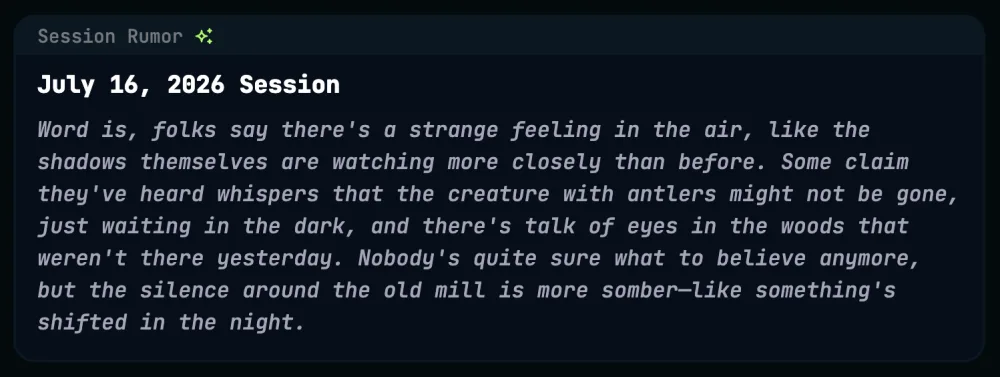
Rumors are the club's news. The setting is Enable Non-Participant Session Rumors, it is on by default, and while it is on, anyone who was not in a session sees a Session Rumor in place of its summary and transcripts: in-world hearsay that hints at what happened without confirming who did what or how it ended. Participants, admins, and the owner always see everything, so whoever runs the club keeps the full picture. Any session can be granted to specific members from its edit form.
People can follow without playing. Members can join live sessions, roll dice, post in the Gamestream, and applaud. Audience members are followers of a public realm who watch and cheer without taking a seat. Collaborators create and edit content, admins manage members and settings.
| A shared world in a Discord and a wiki | A shared world in a realm |
|---|---|
| One GM holds continuity in their head | Several Collaborators run sessions in one compendium |
| Everything or nothing, per channel | Rumors by default, full access granted per session |
| Other groups' sessions are spoilers or silence | Other groups' sessions arrive as in-world news |
| Contributions scroll away | Explorations and notes keep their place in the compendium |
| The wiki goes stale | Entities filed from play, updates approved by a person |
One honest note: rumors are written from the whole session, hidden compendium entities included. They are built to stay vague, but in a club where several groups are circling the same secret, read the rumor before the other groups do.
How session rumors workShared World FAQ
What is a shared world campaign?
One persistent setting played by more than one group, often with more than one GM. Sessions are self-contained, the world is continuous, and what any group does becomes true for everybody.
How many people can play in one world?
In Realms of Shod, a realm holds up to 48 members. A session is whatever subset of those members is playing, and live video is capped at 8 simultaneous streamers.
Can two GMs run different groups in the same world?
Yes. Starting a session is a Collaborator permission, so several members can each run their own games in one realm and share a compendium and history.
How do you stop one group from spoiling another?
Session rumors. Anyone who was not in a session sees a short piece of in-world hearsay instead of the summary and transcripts. It is on by default, and specific sessions can be granted to specific members.
Is this the same as a West Marches campaign?
It is the same idea with less staffing. West Marches games use player-driven scheduling and a shared map; this adds a record that tracks who knows what, which is the part those campaigns usually maintain by hand.
What do members do when they are not in a session?
Publish a Backstory Exploration, write notes linked to compendium entries, read the rumors from other groups, and applaud what happened. None of it requires the GM to write anything first.
Do we need a public realm for this?
No. A private realm of 48 members works the same way. Public realms add an audience: followers who watch and cheer without playing.
A World Big Enough to Come Back To
A club outlives a campaign because it does not depend on the same five people being free. Give a world more than one GM, more than one group, and a record that tells each member only what they could plausibly know, and the thing stops being a standing appointment. It becomes somewhere your friends happen to go.
Realms of Shod is free to start. If you are weighing who in the club should be able to run a session and who should only hear the rumor, read how roles and permissions work.
One World, Many Tables, Per-Person Truth
The upgraded frame: a shared world needs a record that knows who you are. Not one canon document, but one canon with a different surface for each member, depending on what they were present for.
What that requires, with any tools: